Study Abroad

Discover the immersive education offered by Landmark College's study abroad programs.
Studying abroad can be one of the most rewarding and life-changing experiences students have during their college years. And we are thrilled to offer incredible study abroad (in other countries) and study away (within the United States) opportunities for our students.
Our programs are led by Landmark College faculty and designed with careful attention to the structure of program itineraries, a focus on student support, and an emphasis on safety. The programs generally include one three-credit course, helping students stay on track for graduation while experiencing a new culture and location. Students often use this opportunity to explore a topic of interest to fulfill major or general education requirements, or for elective credits.
Experiencing a new location and culture offers students an enviable chance to learn about the world and themselves. We find it is especially valuable for neurodivergent learners. See this resource on the Benefits of Study Abroad for students with LD or ADHD. to learn more.
Upcoming Programs
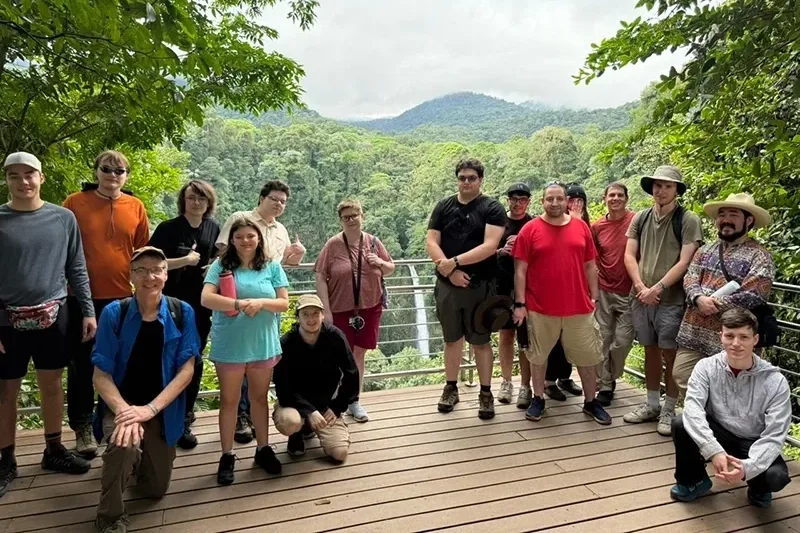
Join us for exciting programs in London and Costa Rica!

Past Programs
Programs offered in recent years include Costa Rica, London, the United States Virgin Islands, New York City, the Netherlands, and Quebec City.
Health, Safety, and Support While Studying Abroad
We prioritize student comfort, joy, and safety during our adventures away from campus.
For answers to common questions or individual concerns, explore the sections below.
New foods, jetlag, air travel, and a change in climate can all affect student health while abroad. In addition to the usual coughs and colds, program destinations may present additional health risks related to heat, food, water, or local flora or fauna.
As a part of our program planning process, Landmark College faculty leaders and program administrators complete thorough research into the health risks of each program location and how to mitigate those risks. Students are presented with thorough guidelines and advice for staying healthy.
In case a health issue arises on our programs, leaders have identified local resources in each location, including English-speaking doctors, walk-in clinics, pharmacies, hospitals, and trauma centers. Each program has at least two leaders as well as local program contacts, so students who need care will not have to fend for themselves.
Participants in Landmark College programs abroad are automatically enrolled in health insurance for the duration of the program abroad. Insurance covers emergency medical treatment for sickness and injury, as well as emergency medical evacuation and repatriation.
Students who currently see (or have recently seen) a mental health professional are encouraged to talk with their counselor or therapist about their plans to study abroad. We suggest that students consider their strategies for coping with new and different situations and develop a plan for responding to any feelings of destabilization, culture shock, or other issues connected to the student’s mental health history.
We encourage all students to disclose their health and mental health history on Landmark College’s program confirmation forms (see “Forms, Fees, and Deadlines,” left) and to keep lines of communication open while abroad. If necessary, the College may be able to arrange for a student to visit a counselor while abroad, although it is important to note that awareness of and education about mental health conditions vary widely by country.
Students who are curious or concerned about how issues such as anxiety or depression may impact their study abroad experience can find useful resources here:
Articles
- Managing Mental Health While Abroad
- Successful Study Abroad with a Mental Health Condition
- Steps to Prepare for Study Abroad if You Cope with Depression
- How to Study Abroad with Anxiety
Personal Accounts
One of the strongest characteristics of Landmark College’s study abroad programs is the high level of student support they offer students. Students participating in a study abroad program may need support for academic work, cultural adjustment, homesickness, social relationships, executive function, or a variety of other concerns.
Each program includes at least two faculty leaders: an academic director, who teaches the coursework, and a program director, who coordinates program logistics and planning. Some of the ways these leaders support students are through:
- regular “office” hours for academic support
- frequent reflection sessions with the whole group
- availability to advise students one-on-one
- intercultural expertise and experience living abroad
- support for health concerns
For any questions about student health, safety, and support on Landmark College study abroad programs, please email [email protected] or the individual program faculty.
Levels of awareness and acceptance of homosexuality vary widely across cultures. If you identify as an LGBTQIA+ student, you may have many questions about studying abroad, including concerns about safety.
Depending on the location, students may find their host country has very progressive ideologies and LGBTIA+ students may feel very comfortable being open about their identities. In other locations, students may find that homosexuality is highly taboo or even illegal.
Landmark College program leaders and others in the U.S. can help students understand the culture and laws of the country they plan to visit. We encourage students to share any concerns or questions they may have about studying abroad.
The following resources may be useful:
- DiversityAbroad: Resources for LGBTQ+ Students Abroad
- U.S. State Department: LGBTI Travel Information
- GoAbroad.com: LGBT Student Guide to Study Abroad
- LGBT travel and culture website: GlobalGayz
- International Lesbian, Gay, Bisexual, Trans and Intersex Association (ILGA): Resources
Women’s roles, and cultural attitudes towards women, are also varied around the world. Religion, history, and cultural values can all contribute to gender roles and relationships that might be different from those in the United States.
Female students traveling or studying abroad may be surprised (pleasantly or unpleasantly) to observe and experience different expectations and attitudes towards women in the country they visit. In some places, feminism and gender equality may be commonplace in government, the workplace, and the home. Unfortunately, in some locations female travelers may experience catcalling and stares while out in public, and such things as smiling or making eye contact may be interpreted differently than they would be here. Observing and experiencing these differences can be eye-opening, frustrating, and sometimes frightening.
Landmark College study abroad programs are led by experienced faculty, and nearly all programs are led by at least one person who had significant experience living in the destination country. These leaders can answer questions about gender roles and attitudes, and can share their own experiences.
See the following resources for more information:
- DiversityAbroad: Women Abroad
- Institute for Study Abroad: Safety Considerations as a Female Studying Abroad
- U.S. Department of State: Information for Women Travelers
- University of Chicago: Gender Abroad
Supporting your student’s experience abroad
Much of the health and safety information listed on this page can be useful as your student prepares to study abroad. We encourage you to take a look at the information and links provided, and to contact us with any questions you may have.
Where can I find details about my student’s program?
Individual program web pages provide comprehensive information about the program course, leaders, and locations. For courses that have run in the past, you can see the complete itinerary and read the program blog. Final details for upcoming programs are posted at least a month before departure.
Program web pages include:
- Student Handbook: contains program itineraries, emergency phone numbers, contact information, a suggested packing list, recommended readings, information about housing, and more
- Course syllabus: contains course goals, grading information, and a schedule of coursework and assignments
- Travel information: flight details and meeting times
How much unstructured free time will my student have while abroad?
The amount of free time, and restrictions given to students during that time, vary per program. We encourage you to get in touch with us to learn more about what guidance is given to students for free time.
We realize that students occasionally make short-term, individual travel plans during a program. If so, they are required to provide their itinerary and contact information for the place(s) they will be staying to the Program Director. We strongly recommend that students also inform their families of any individual plans.
How will I be in contact with my student while they are abroad?
On most programs, students will have frequent, but not constant, internet access, and you can be in touch by email, on social media, or through communication apps like WhatsApp, FaceTime, Skype, or Google Duo. However, we strongly encourage students to consider how closely they want to be in touch with family and friends back home. We encourage students to unplug as much as possible in order to focus on the intercultural and academic aspects of their program. Parents and families will be given emergency contact numbers for program leaders and can also contact Landmark College in an emergency. We suggest that you talk to your student ahead of time to establish reasonable expectations for communication.
Program blogs, maintained by faculty with input from students, are a great way to keep up with program activities. Please take a look at the various program blogs here.
Supporting your students’ health and safety while abroad
The Office of Experiential Education collects health and mental health information via a self-disclosure form submitted by students after they have been accepted to their programs. You will have access to these forms. It can be helpful to review these forms early, and meet with individual students as necessary to help them prepare for their experience abroad.
The following are some articles and resources that may be helpful:
- Resources for Health and Safety in Education Abroad
- Leading Short-Term Education Abroad Programs: Know the Standards [Free download]
- Study Abroad Programs Should be Prepared for Mental-Health Crises, Speakers Advise
- Addressing Mental Health Issues Affecting Education Abroad Participants
- Anxiety and Stress Go Abroad [Poster presented at NEFDC Conference 2019]
- Anxiety and Stress Go Abroad [Handout accompanying poster presentation at NEFDC 2019]
The following resources were presented at the CIEE Annual Conference in November 2021. The conference information, including the PowerPoint presentation, will be available through the end of 2021. The resources at the bottom of this page will remain after that time.
Presenters:
Susan Holme, Director of Off-Campus Studies, Whitman College
Andy Donahue, Director of Social Pragmatics, Landmark College
Jessica Lindoerfer, Director of Experiential Education, Landmark College
Antonia Keithahn, Associate Director of Academic Resources, Whitman College
PowerPoint Presentation:
Access to Education Abroad for All: Serving Students with Anxiety, Autism & More (PDF)
The following resources may be useful to students, faculty, staff, and administrators.
Autism-Specific Study Abroad Resources:
Mobility International (MIUSA) is an organization whose mission is “To empower people with disabilities around the world to achieve their human rights through international exchange and international development.” Their website contains a plethora of resources for students, administrators and faculty.
A search for keyword “autism” brings up a large library of fact sheets, student testimonials, and other references. These can be used to educate oneself and empower students. Here are a few highlights:
15 Tips for Planning an Autism-Inclusive Exchange Program
Air Travel Tips for Autistic Passengers
Student Experiences in Jamaica, China, and Scotland
MIUSA also includes a collection of sample accommodation forms and resources for study abroad administrators. These can be extremely useful when advising students about study abroad options.
Neurodiversity Training Resources:
The following resources are not specific to international education, but provide valuable opportunities to learn about neurodiversity in an educational context.
Landmark College Institute for Research and Training (LCIRT)
The Landmark College Institute for Research and Training’s (LCIRT) mission is “to expand neurodiversity-based research and leverage innovative practices to improve educational and career outcomes for neurodivergent individuals.” LCIRT offers a variety of professional development opportunities, including webinars, a certificate program, workshops, trainings, and their annual Summer Institute for Educators.
Printable LCIRT flyers:
Professional Development Options
Certificate Program in Learning Differences and Neurodiversity
Other Neurodiversity Professional Development Resources:
CUNY Neurodiversity Conference
Stanford Neurodiversity Summit
College Autism Network’s College Autism Summit
Learning Disability Association of America: Webinars and Conferences
Additionally, our Office of Experiential Education and program faculty leaders are readily available to assist students throughout the application, pre-departure, and on-location phases.
Want to learn more about our Study Abroad program?
Jessica Lindoerfer
Director for Undergraduate LC Online and Intersession Programs
[email protected]
802-387-7230
Lewis Building 215