Bachelor of Science in Health Sciences
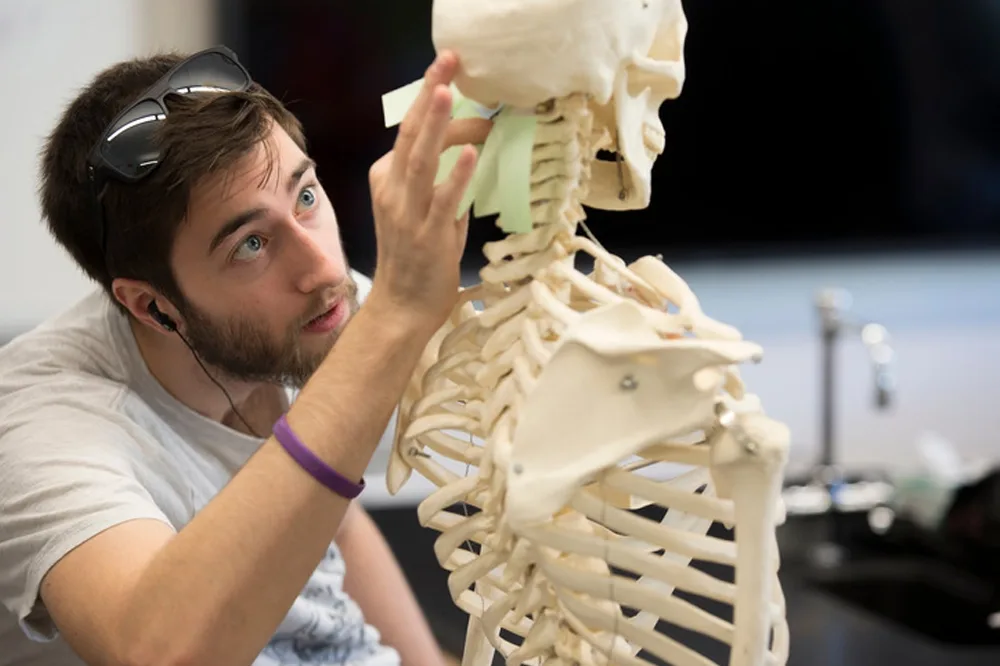
Helping others achieve a higher quality of life through health and wellness.
The Bachelor of Science in Health Sciences is designed for students who are interested in working in the healthcare industry. The multi-disciplinary curriculum provides learning experiences in laboratory, classroom, and out-of-classroom settings with a focus on human anatomy and physiology, body mechanics, wellness interventions and strategies, and health care systems. Students are prepared for entry-level service positions and establish a foundation for further study in areas such as nursing, physical therapy, allied health, or other wellness careers. Students have the option of focusing their interests in biology, chemistry, health, or wellness through upper division requirements and electives, as well as internship opportunities.
Learn more about the B.S. in Health Sciences Degree
Engaged in a deep exploration of the scientific method and how it applies to human wellness, students have firsthand learning opportunities in laboratory settings, classrooms, and out-of-class experiences. Knowledge areas include a focus on human anatomy and physiology, body mechanics, wellness interventions and strategies, and health care systems.
Wellness initiatives are an integral part of the college’s ethos, and students can expect a variety of co-curricular opportunities focused on the physical, mental, and social dimensions of wellness. Students in the Health Sciences major enjoy serving on advisory committees, competing in health challenges, and guiding improvements for campus accessibility.
Students are actively engaged in research with faculty, including presenting at national conferences, publishing in peer-reviewed journals, and supporting other STEM scholars through mentorship. Students have contributed to publications such as The Chronicle of Mentoring and Coaching and The Journal of Science Education for Students with Disabilities.
A variety of internships in health or health-related fields are available. Students have interned at Boston’s Children’s Hospital, Tufts Point 32 Health, Vermont Biomedical Research Network, Vermont Genetics Network, and Liberty Mutual, to name a few. On-campus and local internships are available as well.
Graduates will have the flexibility to work in in a range of settings, including
- Hospitals and clinics
- Research institutions
- Government and community agencies
- Public health
- Nonprofit organizations
The curriculum forms the foundation for further study in professional health careers such as
- Nursing
- Physical therapy
- Allied health
To earn the B.S. in Health Sciences degree, students must complete 120 credits:
- 55 credits of major required courses
- 36 major required credits
- 19 major required credits that also count toward general education
- 21 additional credits to complete the general education requirements
- 44 credits of general electives (17 must be at the 3000/4000 level)
Major Requirements (58 credits)
- BIO1521 Principles of Biology I
- BIO1522 Principles of Biology II
- BIO2521 Anatomy & Physiology I
- BIO2522 Anatomy and Physiology II
- BIO4000 Biology Capstone
- BIO4011 Research Methods and Design
- CHE1521 Principles of Chemistry I
- CHE1522 Principles of Chemistry II
- MAT2621 Applied Statistics
- NSC3011 Writing in the Sciences or WRT3011 Advanced Writing
- PSY1011 Introduction to Psychology
- INT3023 Careers after College or 3000/4000 level Health-focused Internship
- One four-credit 3000 to 4000 level course in BIO, CHE, or HTH
- Two 3000 to 4000 level courses in BIO, CHE, or HTH
- One 3000 to 4000 level course in BIO, CHE, or HTH or one of:
- COM3064 Communication Ethics in New Media World
- EDU3013 Neurodiversity in Culture and Community
- PSY3041 Psychology of Emotion
- PSY3051 Psychopathology & Mental Health
Additional General Education Requirements
- WRT1011 Composition and Rhetoric or WRT1008 Writing Process & Practice Part 2
- WRT1012 Research and Analysis
- EDU1011 Perspectives in Learning
- COM1011 Intro to Communication or COM1021 Interpersonal Comm or COM1071 Public Speaking
- Humanities distribution elective
- Creativity distribution elective
- Career Development: EDU2032 or EDU2061
General Electives: 44 credits (17 at the 3000/4000 level)
120 Total Credits
Upon completion of the B.S. in Health Sciences degree, students will be able to:
- Apply the scientific method when investigating scientific questions and phenomena.
- Explain how anatomy and physiology relate to human health and disease.
- Evaluate relevant literature to explore a scientific question or topic.
- Present scientific concepts in a format appropriate to a specific audience.
- Explain the relationship of structure and function from the atomic level to the organismal level in the human body.
Questions about the Bachelor of Science in Health Sciences?
Kevin Keith
Chair, STEM Department
802-387-6853
[email protected]
Jim Kraly
Dean of STEM and Professional Studies
802-387-6825
[email protected]

Interested in applying?
Whether you are new to Landmark College or are a former student interested in returning for a baccalaureate degree, you can apply here (the reenrollment process for Landmark College alumni can be found under the "Returning" tab).