Academic Support Services

The Landmark College Difference
Landmark College offers our students a dedicated faculty and staff that bring specific expertise in, and a passion for, working with students who learn differently. Landmark College offers the same range of student services found at any college — from counseling and health services to student life and athletics.
Landmark College Student Success Model
An Integrated Approach to Supporting Student Growth
At Landmark College, student success is rooted in understanding the whole learner. Recognizing that the needs of neurodivergent students are interconnected, Landmark uses an integrated model of support that aligns academic achievement, personal development, and career readiness.
Landmark's student success model brings together Academic Advising, Career Advising, and the Drake Center for Academic Support within a coordinated framework designed to help students access the support they need throughout their college experience. Through intentional collaboration among advisors, tutors, and student support professionals, the model strengthens communication across departments and fosters a more connected approach to student growth and persistence.
The model recognizes that meaningful success requires both institutional support and student engagement. By connecting these areas more intentionally, Landmark helps students better understand the relationship between who they are, what they are learning, and where they want to go, while encouraging them to actively participate in their development and build the skills, self-awareness, and confidence needed for long-term success.
Academic Support at Landmark College
Video contains closed captions. For a descriptive transcript, please access Video Transcript – Academic Support at Landmark College.
Academic Advising
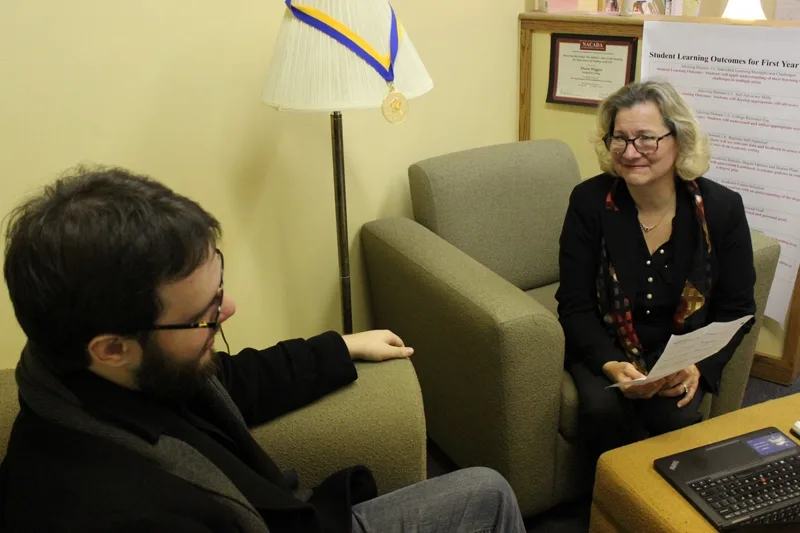
Your advisor works with you on course planning, goal-setting, and connecting you to support across the college. Academic Advising takes a student-centered, developmental approach from your first day at Landmark.
Advisors help students:
- Plan and manage course schedules
- Identify academic strengths, interests, and goals
- Set short- and long-range academic and career goals
- Build self-awareness and self-advocacy skills
Learn more about Academic Advising.

Career Advising
Landmark's career advising team works in close collaboration with academic advisors to help students connect their strengths, interests, and goals to meaningful opportunities.
Career Advising supports students with:
- Career exploration and goal-setting
- Internship and employment placement
- Professional skill-building workshops
- Transfer and graduate school planning
Learn more about Career Advising.

Drake Center for Academic Support
Over 50% of Landmark students use the Drake Center. Dedicated professionals provide both in-person and virtual support tailored to each student's unique needs.
The Drake Center helps students:
- Organize and plan time
- Understand and respond to reading
- Organize and produce writing
- Use assistive and educational technology
Learn more about the Drake Center.
-
The model recognizes that student success is not linear and that meaningful growth requires both institutional support and student engagement. Academic choices influence career pathways. Career exploration shapes motivation in the classroom. By connecting these areas more intentionally, Landmark helps students better understand the relationship between who they are, what they are learning, and where they want to go.
Learn more about academic support at Landmark College:
The academic advisor is central to the system that supports individual student performance.
In addition to classes, students in their first year at Landmark College participate in weekly academic advising sessions while engaged with the advising curriculum.
As students progress in their coursework in their second year, they become increasingly independent and meet with their advisor less frequently.
Students pursuing their bachelor’s degree work with degree-specific advisors.
Please visit The Drake Center for Academic Support page for more information.
The Landmark College Health, Counseling, and Wellness staff supports students' physical and emotional well-being. Visit their page for hours of operation, instructions for making an appointment, and more.
Students can receive educational technology guidance from The Drake Center for Academic Support.
The Drake Center helps students take advantage of the wide array of technologies that support the needs of students who learn differently.
Students who are academically prepared for college may still face significant challenges navigating the social curriculum and adjusting to the more fluid routine of the college student.
Landmark College recognizes the need to provide additional programming to assist such students, including those with an autism spectrum condition, to meet their college goals.
Our integrated services model for social pragmatic support services provides a structured living and learning environment that combines an effective pedagogical approach with tailored social and other programmatic supports.
The Landmark College Library offers walk-in assistance as well as one-on-one appointments with students to assist them with their research projects and with developing information literacy.
The Library building offers a welcoming space conducive to individual and small-group study, as well as resources to support students’ curricular and extra-curricular needs and interests.
Students often find that relying on a scheduled study time is important. Study support sessions offer a small-group setting where students can work quietly with the option of setting small goals for work completion with check-ins to help increase focus and production. This support is guided by professional staff.
The Drake Center offers synchronous online academic support using Microsoft Teams. When scheduling appointments students have the option to request a virtual appointment during regularly scheduled hours.
This service is available to both residential and online students.
In addition to office hour appointments with individual faculty members, students are encouraged to access science support by appointment in the Drake Center.
Support and instruction is available for all science-specific needs, including:
- Writing lab reports
- Textbook study
- Vocabulary building techniques
- Scientific writing
Drop-in support is offered for students who need day-of support. Students will often have access to staff one-on-one during drop-in hours, but they may need to share time with other students. If multiple students show up for drop-in hours, staff will move between students, offering 1:1 support in a rotation. Drop-in hours vary semester-to-semester.
Math support is offered by appointment in the Drake Center, and can be scheduled online, or by contacting the Drake Center. Math support is provided by math faculty and Drake Center support staff.

Executive Function (EF) Coaching
Landmark College provides executive function support through advising, coaching, universal design-based pedagogies, and integrated technologies.
Outside the classroom, we provide executive function support through our robust student life curriculum that includes highly trained residence hall deans (RDs) who understand the challenges related to still-developing executive function skills.
Academic Placement
We use a placement approach that takes into account students’ learning strengths and needs.
Students come to Landmark College with varying abilities in reading, writing, math, and information literacy. In our placement process, we review enrollment materials provided during the admissions process to recommend course options that meet the writing requirements, education requirements, and math requirements. Our recommendations are based on previous coursework, the admissions essay, achievement scores, and other supplemental information.
We want our students to be successful, and our placement process is designed to meet the needs of students, to meet collegiate standards, and to be sure that students are placed accurately in their foundation courses.
The courses in this foundation—writing, education, and math—serve as prerequisites to all other courses required for degree completion. These courses focus on delivering content while providing explicit instruction in what is often referred to as “the hidden curriculum.” Students are introduced to study strategies, writing process strategies, active and critical reading approaches, self-management techniques, and organization and time management skills. There are options recommended for the writing and education sequence. In addition, students will be assessed for math placement and advised on a pathway to meet the math requirement. Coursework may vary by degree plan.
Learn more about academic placement:
There are two options for meeting the first part of the writing requirement sequence.
Option 1: One Semester
WRT1011 Composition and Rhetoric
This course emphasizes the interconnected nature of writing and reading at the college level. Students develop and refine individualized writing and critical reading processes while working with a variety of rhetorical strategies and structures. Students are asked to express their ideas and integrate material from texts through participating in class discussions, completing informal assignments, and writing academic papers of increasing length and complexity. To meet the writing requirement through this option, students must earn a “C.”
Option 2: Two-semester Sequence
WRT1007 Writing Process and Practice: Part 1
WRT1008 Writing Process and Practice: Part 2
WRT1007 is the first-semester pass/fail credit elective course in a two-semester sequence to meet the WRT1011 requirement. This course introduces the core concepts of college reading and writing, and students learn to construct writing that is clear, well-organized, and concise. While engaging in a series of shorter assignments, students will develop their reading and writing processes, applying these processes to a variety of genres and rhetorical structures. Students also strengthen their abilities as college readers by further developing their active and critical reading strategies to comprehend and analyze texts. The following semester, students enroll in WRT1008, where they complete writing that meets the learning outcomes for the requirement. This course is letter-graded. To meet the writing requirement through this option, students must pass WRT1007 and earn a “C” in WRT1008.
There are two placement options for meeting the education requirement.
In order to meet the education requirement, students must take EDU1011 Perspectives in Learning. However, students may be recommended to start with EDU1007 College Learning Strategies.
Option 1: Direct placement into EDU1011
EDU1011 Perspectives in Learning
This first-semester course is designed to introduce students to theories related to the cognitive, social, emotional, and cultural dimensions of learning. The purpose of the course is to foster self-awareness, critical thinking, strategic learning, and self-advocacy. Metacognition and critical thinking will be prominent themes throughout this course. Students will reflect on learning and teaching processes while applying learning strategies that can be transferred to other courses of study as a proactive approach to self-advocacy. Strategies for active reading, note-taking, test-taking, long-term project planning, and organizing materials will be modeled, practiced, and assessed. Students will be expected to critically read, discuss, and utilize a body of readings for a variety of academic tasks. In addition, students will learn about the laws that protect individuals with disabilities, receive an in-depth orientation to the on-campus services that provide academic and emotional support, and establish short and long-term goals related to promoting effective self-management.
Option 2: Placement into EDU1007 followed by EDU1011
EDU1007 College Learning Strategies
In this course, students will develop awareness of how they learn through the development of metacognitive learning strategies and approaches to reading, note taking, and executive skills like task management. Strategies are presented and practiced for students to enhance their learning experience. Strategies are explored in the following ways: 1) what they are; 2) how to use them; 3) when to use them; 4) why they are effective; and 5) how to adapt them. This class takes a unique approach towards the learning experience through an emphasis on overall wellness and the practice of stress management and relaxation techniques that can make a difference. Use of technology for learning will be emphasized throughout.
Entering Landmark College students take an online math placement assessment through ALEKS, an adaptive learning program. Students transferring math credit from another college/university (or from high school AP coursework) may be eligible for a math placement exemption. These students should contact the Director of Academic Support and Placement to determine if they need to complete the math placement assessment. Students must submit official transcripts and score reports to the Registrar’s Office before it can be determined if they need to complete the math placement assessment in the student onboarding portal.
Students who take the math placement assessment are assigned a level based on where their performance falls relative to the institution’s cut scores. Each level corresponds to one or more math courses to help guide students toward coursework that most appropriately matches their knowledge and skill level. Math requirements vary by degree plan.