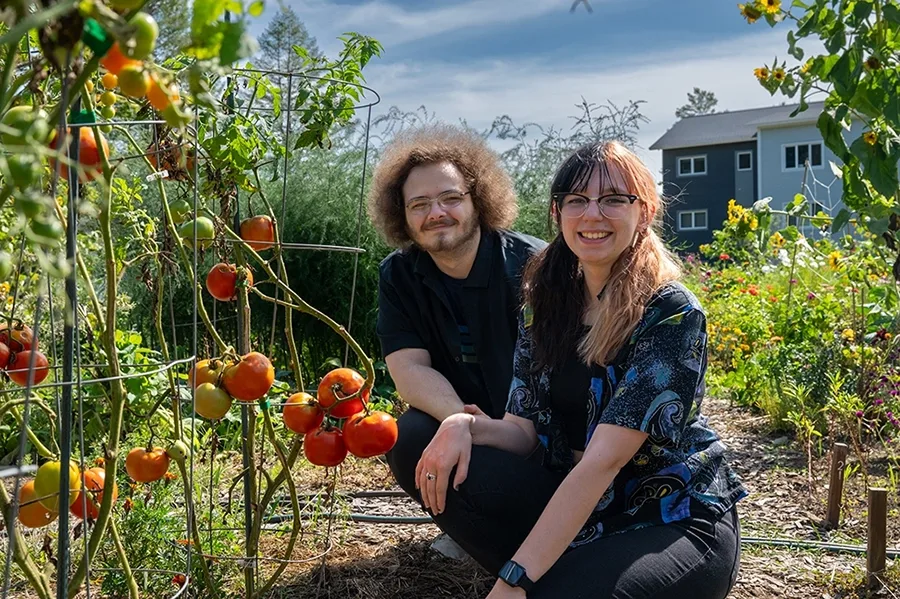
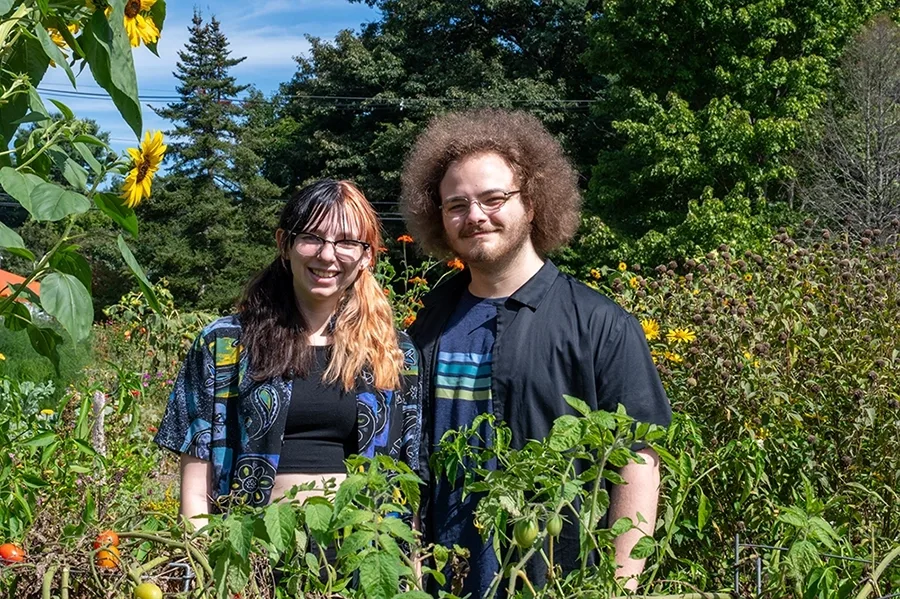
Students Lee Dufresne and Isaac Fynewever-Muyskens want to improve the lives of their fellow neurodivergent learners in workplaces everywhere. One of the places they’ve started is in agriculture.
This past spring, they carried the torch from a previous student who posed the question of why there are a disproportionate number of neurodivergent individuals working in agriculture. They did their own research — and realized how much more research needed to be done.
“What we discovered was that it was too difficult to find whether or not the initial statement was true,” Fynewever-Muyskens said, referring to whether there really are a high number of neurodivergent individuals working in agriculture.
So instead, they formed a new question: What would make agricultural workplaces better for neurodivergent workers?
Their research would end up being presented by Assistant Professor of Sociology Matthew Hoffman at the annual conference of the Agriculture and Human Values Society in Burlington, Vt., in June.
“I was pleased to be able to present their work and to give them credit for it,” Hoffman said.
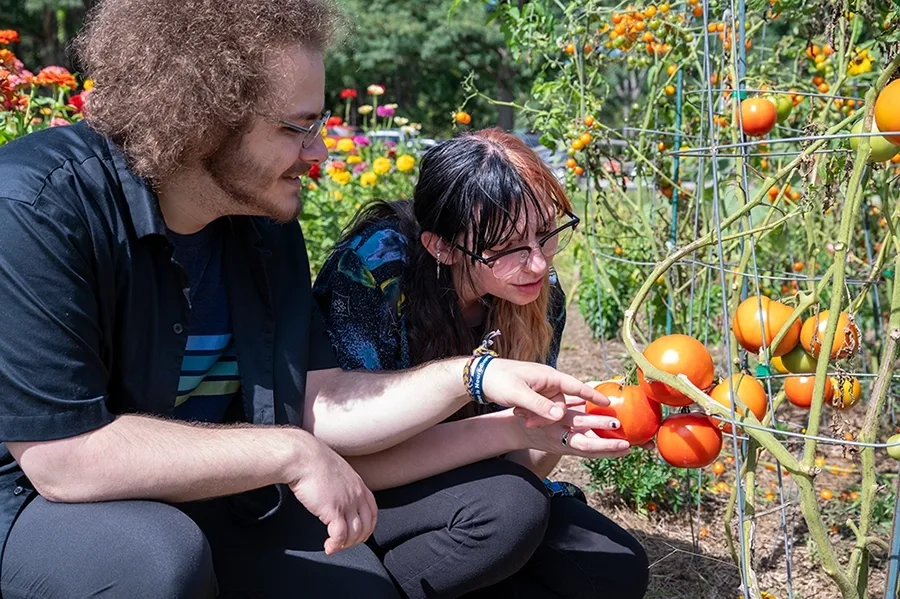
Dufresne and Fynewever-Muyskens are among many students who have followed their natural curiosity and passion into research opportunities while still undergraduates at Landmark College.
“Just to imagine our work — a couple of college kids, underclassmen at the time, putting this work out there and having it be seen by professional scholars,” Fynewever-Muyskens said.
Dufresne and Fynewever-Muyskens found that an ideal workplace would include: flexibility, accommodations, understanding, and the highlighting of strengths. For agriculture specifically, their proposed path forward involves online surveys and interviews, and distributing information via small farms and organizations.
Looking ahead, they hope to continue their research, returning to a broader focus of workplaces in general, maybe integrating education.
"My life goal, (and) the reason why I’m at Landmark is, I want to improve the lives of neurodivergent people as much as possible," said Fynewever-Muyskens, who is pursuing a bachelor’s degree in psychology. “We want to get to the root of what is causing harm to neurodivergent people and in what circumstances.”
Both students are inspired by their own struggles, and a desire to pay it forward.
Dufresne recalled graduating high school and vowing never to go to college. After spending some time in the workforce, they ended up enrolling at Landmark College via online classes, then decided to come on campus. Now, they are on track toward their longtime goal of becoming a nurse.
“I wanted to go to nursing school — that had always been a dream of mine — and go into the health care field, but it just didn't feel attainable with how I was at that time,” Dufresne recalled. “But since I've been at Landmark, I've learned how to live on my own. I've learned how to advocate for myself and how to function.”
After finishing their associate degree in biology, Dufresne plans to pursue a bachelor’s degree in health sciences.
“Landmark — I don't even know how to describe it. People say, ‘oh, something changed my life.’ But like, no, it quite literally changed my life,” Dufresne said. “It gave me a home, a place where I feel I belong.”
Fynewever-Muyskens described growing up with good support systems, noting that other members of his family shared and understood his struggles.
“I think that's where all of my support kind of came from, because they saw themselves in me and they wanted to give to me what they weren't given,” he said. “I feel like I need to pay that forward.”
‘I felt like a real scientist’
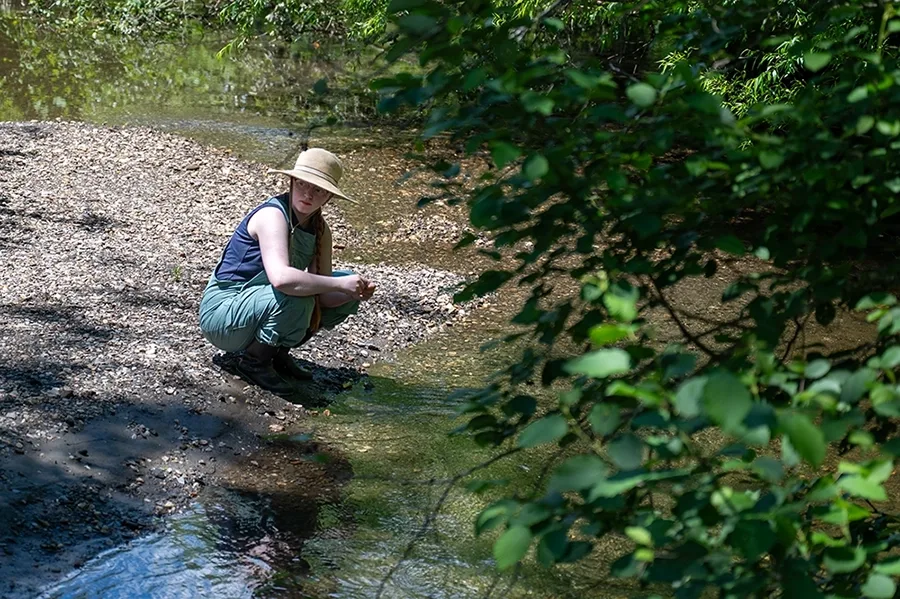
Student Laura Sacktor wondered if beaver dams — known to filter out pollutants — affect the level of microplastics in the water. Sacktor began to research this question for a class, and then continued as part of a summer research internship.
She set up field cameras and collected water samples from the wetlands off of Sand Hill Road in Putney, just off Landmark's campus. These samples were examined by microscope in the labs of the MacFarlane Science, Technology, and Innovation Center. There, Sacktor surveyed how many microplastics were in each sample. Her research thus far has indicated that, yes, there are fewer microplastics in the water after being filtered through a beaver dam.
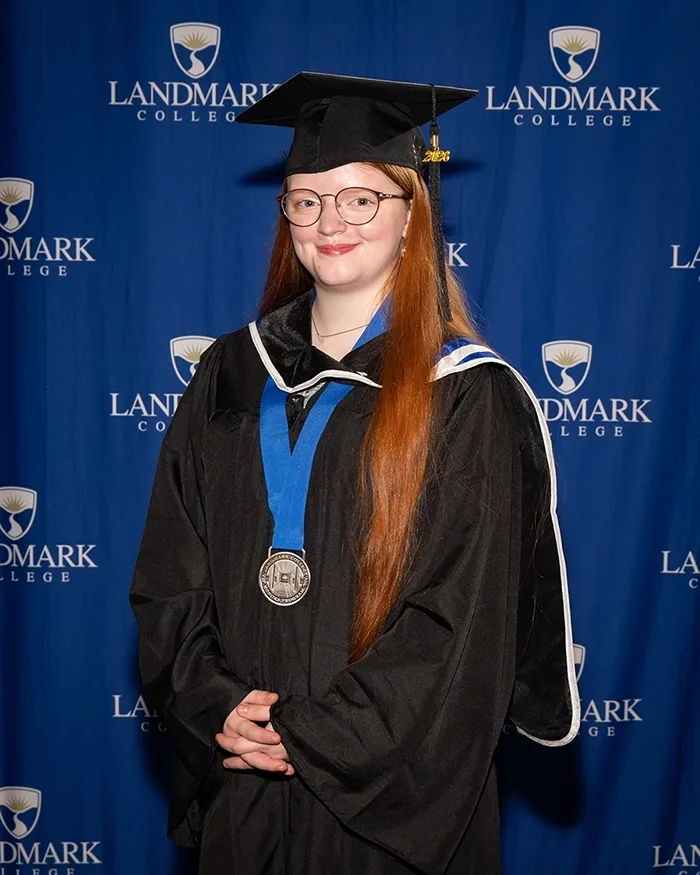
“It’s been really amazing,” Sacktor said. “I really felt like a real scientist.”
She is preparing to present her completed findings at a conference next spring, and hopes to publish a journal article detailing her findings.
“The fact that I could be author on a real, actual scientific study is amazing,” Sacktor said.
Sacktor came to Landmark as a transfer student, and after taking a year off to work.
“I wasn’t sure if I wanted to go back to college because I was kind of really scared of it,” Sacktor said.
Her mother found Landmark and Sacktor attended an Open House, where she liked what she saw.
“I was like, ‘I’ll just be here for a year,’ and that was two years ago,” Sacktor said. She is now pursuing a Bachelor of Science in health sciences. “I have friends here. The teachers are amazing. The campus is absolutely gorgeous. I love all the opportunities I’m given.”
Building confidence, opening doors
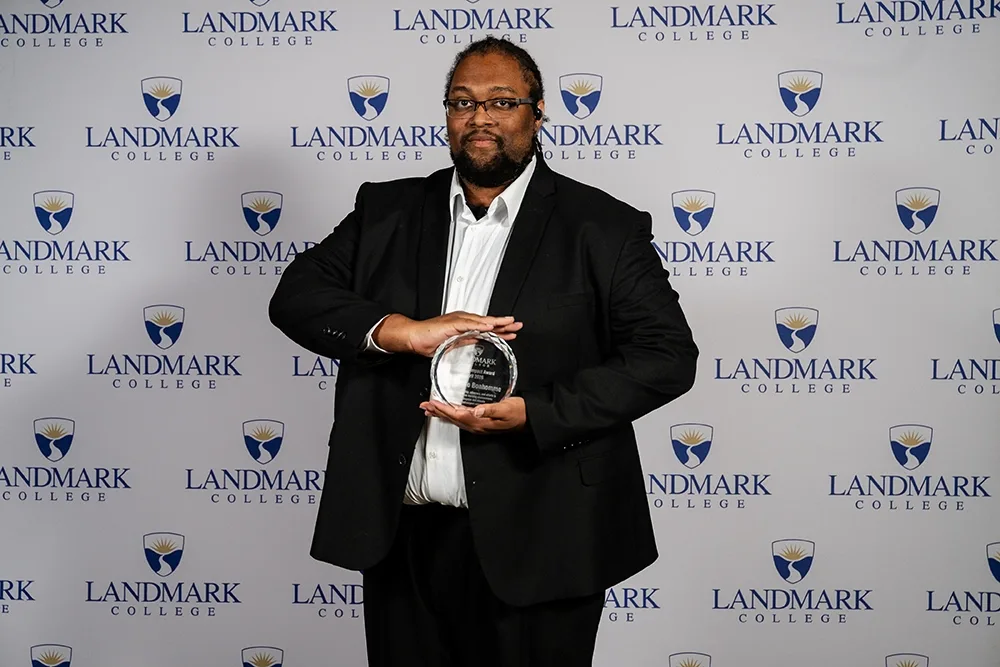
Recent alum Anastasio Bonhomme ’26 was part of the College’s Access to Innovative Education in Science, Technology, Engineering, and Mathematics (AIE-STEMPLOS) Scholarship Program. Earlier this year, he was a co-author on a peer-reviewed article documenting how the program supports neurodivergent scholars pursuing fields such as computer science and biology.
Bonhomme graduated in May with a Bachelor of Science in biology. He said over the course of his time at Landmark, his confidence gradually increased. He arrived here after struggling at previous colleges.
“Accommodations are baked into the framework of everything here, (which) has been incredibly helpful in not just making progress, but also discovering more about how I operate,” Bonhomme said.
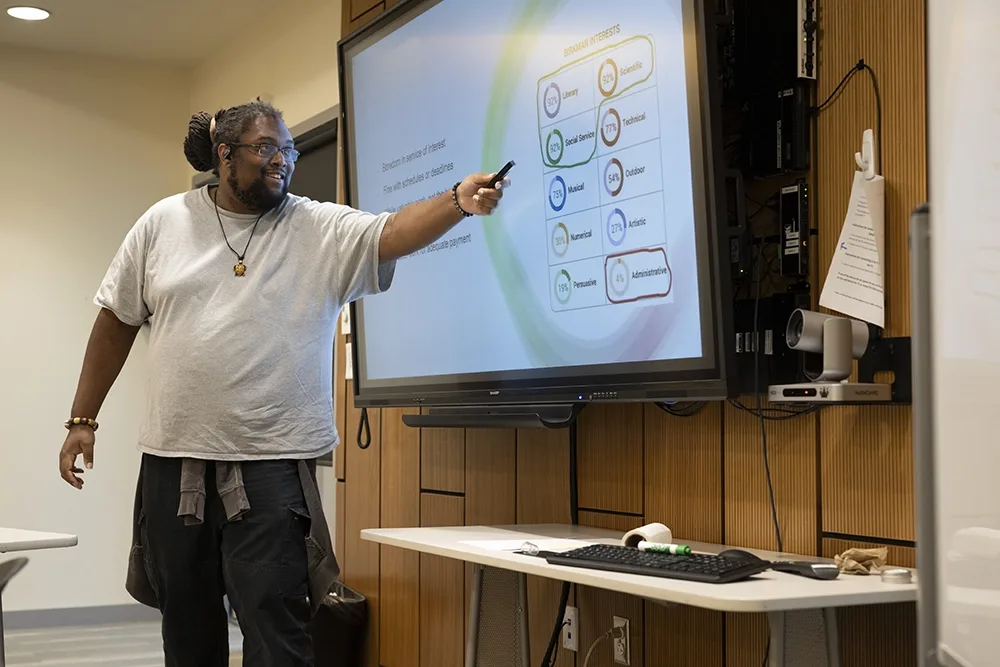
He noted his challenges with writing as an example. Though he has been told he writes well, he describes the act of writing as “almost painful.”
“I have never been able to figure out why, but a great deal of what I’ve been able to work on here is exploring alternatives to maybe, having to write a seven-page paper,” he said.
Some professors, he said, gave him the option of taking an exam in an interview format.
“I can just sit down with them for 10, 20, 30 minutes and exhibit my knowledge of a topic, as opposed to having to sit down in front of a computer for 10, 20, 30 minutes and write about it, which for some reason is excruciating,” he said.
While a student, he completed research-based internships for scholars at Cornell University and Thomas Jefferson University, along with an internship assisting Landmark College Associate Professor Kimberly Coleman. As part of his work with Coleman, he created an educational dice game on to model disease transmission that Coleman has since used in her classes.
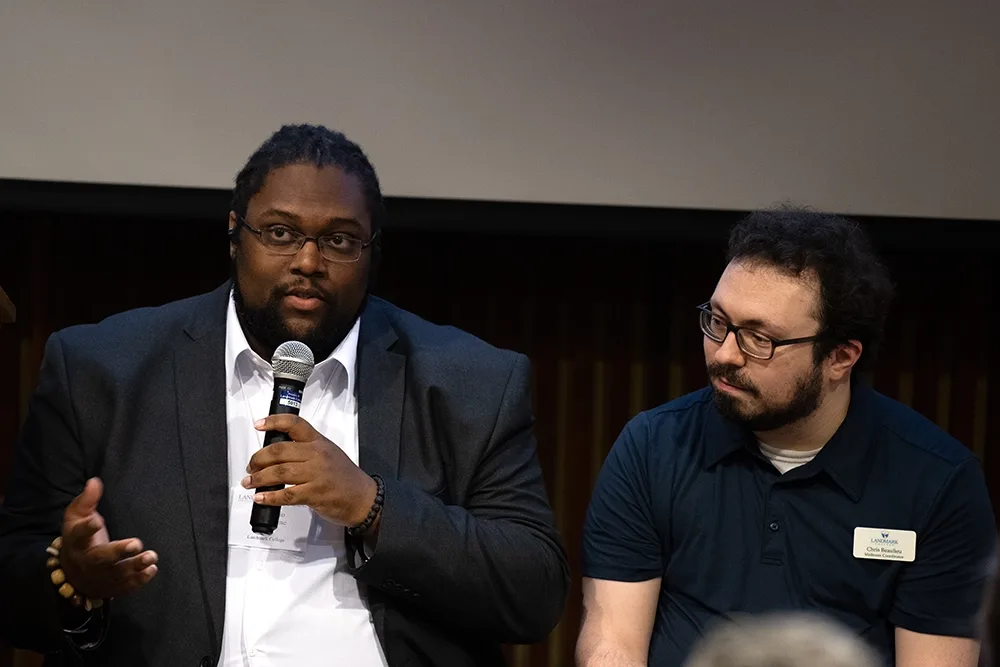
“I don’t think, when I first got here, I would have anticipated even like, just 30, 40 percent of what I’m doing (as a student),” Bonhomme said. “I definitely didn’t see myself flying out to California for conferences, or presenting my own research.”
Upon graduation, Bonhomme won the Undergraduate Research Award, in addition to the President’s Award. He also received the Student Impact Award in recognition of his leadership on campus at Landmark College's 2026 Spring Gala in New York City.
“Anastasio thrived at Landmark,” said his mother, Nadja Bonhomme. “They saw him.”