The New Accessibility in Higher Education
A New Era for Accessibility in Higher Education Necessitates a New Book to Discuss It!
Vice President for Neurodiversity Research and Innovation, Landmark College
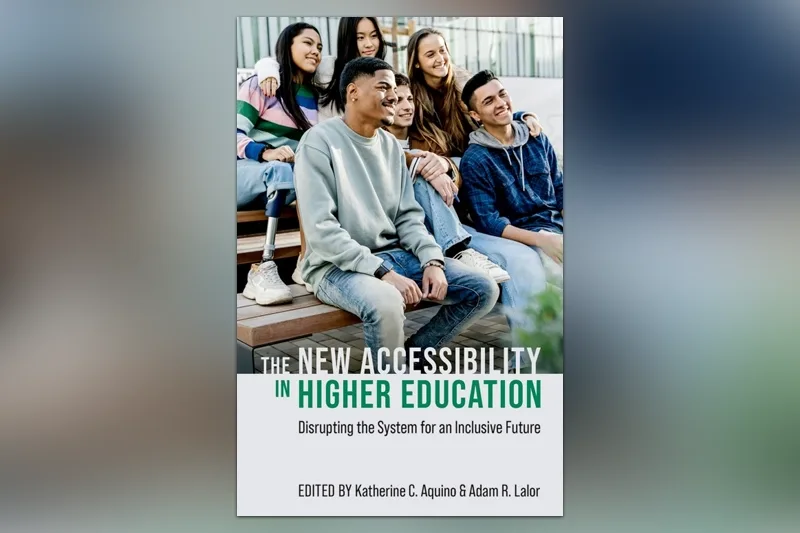
Bob Dylan’s famous lyrics, “the times they are a changin’,” aptly describes the evolution of thought related to higher education and accessibility over the last 15 years. As American society has undergone substantial change due to the COVID-19 pandemic, socio-political activism, and rapid technological advancement in the form of artificial intelligence, higher education’s relationship with disabled people and accessibility has also changed. In the past, making higher education accessible to disabled people has been worked toward somewhat begrudgingly by colleges and universities. Despite the Rehabilitation Act and the Americans with Disabilities Act being signed into law more than three decades ago, higher education institutions are still working to achieve basic compliance as evidenced by multiple lawsuits related to disability-related discrimination. But change is afoot!
The recently released book, The New Accessibility in Higher Education: Disrupting the System for an Inclusive Future published by Oxford University Press, which I and Dr. Katherine Aquino of Rutgers University edited, examines the last 15 years as a turning point for disabled people in higher education, a turning point that has brought about increased access and new conceptualizations of disability and accessibility. Consisting of 14 chapters, the editors have assembled a group of authors that constitute a veritable “who’s who” of higher education and disability scholars including Joseph Madaus, Sheryl Burgstahler, Annemarie Vaccaro, Ellen Broido, and Stephanie Cawthon with a forward by the incomparable Nancy Evans. Authors tackle such topics as accommodation provision, administration, instruction, enrollment, and identity development through new lenses brought about by significant events of the last decade and a half. They delve into critical issues such as engaging disabled people in higher education policy making, test-optional admission practices, and disability and intersectionality. As editors, Dr. Aquino and I highlight themes from the chapters that will guide postsecondary educators in enacting a new accessibility mindset.
Key components of the “new accessibility” framework are:
- Disability is a facet of diversity
- Disability is multidimensional
- Accessibility is a shared responsibility in higher education
- The voice and engagement of disabled people is critical in higher education
As Landmark College Institute for Research and Training staff, the disability and neurodiversity community, and society move forward, it will be important to continue—and double down on—on this “new accessibility” mindset while simultaneously opposing efforts to regress to earlier conceptualizations of accessibility and disability. As quickly as advancements were made during the last 15 years, potential exists for these changes to backslide. In fact, some already have! We can work to prevent this by articulating and leading according to the new accessibility mindset.