Q&A with Mirko Chardin, Keynote Speaker for LCIRT's 2025 Summer Institute for Educators
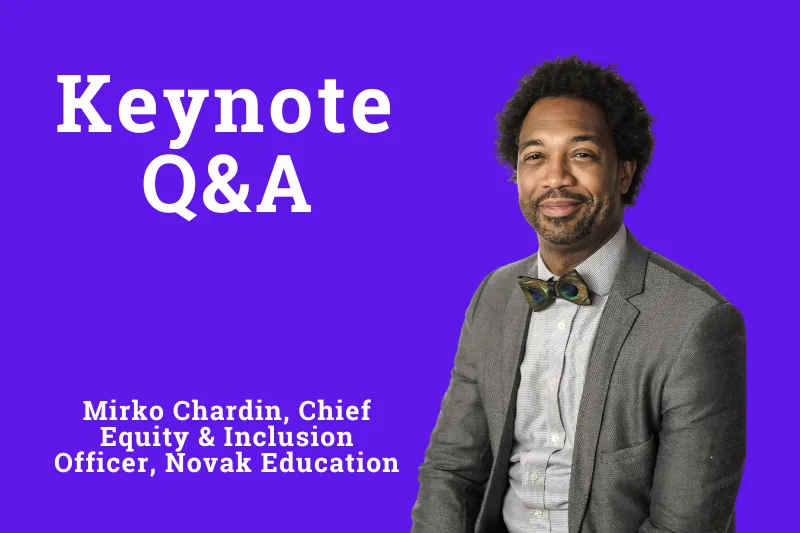
Mirko Chardin is the Chief Equity & Inclusion Officer at Novak Education, and a former teacher and head of school who is a nationally recognized consultant specializing in inclusive teaching and learning and school culture. Chardin is the keynote speaker at the upcoming 2025 LCIRT Summer Institute for Educators.
Q: What are you most excited to share with participants in your presentation and workshop at Landmark College’s Summer Institute for Educators?
A: I’m most excited to support educators in re-centering the learning experience around the people who matter most—our students. Too often, we focus on content delivery and adult-driven structures without pausing to ask: What does this feel like from the learner’s perspective? My hope is to offer a framework that helps educators consistently design for access, relevance, and real belonging from the start—not as an afterthought.
Q: What are just a couple of the tools or takeaway concepts you hope participants will find immediately applicable to their work?
A: One of the most practical and powerful takeaways I’ll be sharing is a framework I call Going Beyond Access, built around three essential questions:
- Are we valuing the impact of our decision-making in and through the lives of our learners above and beyond our intentions?
- Can all learners see themselves reflected in the work?
- Is the work relevant to our learners in real and authentic ways?
These questions serve as a gut check for equity-centered design and help ensure that our planning is grounded in learner reality—not just educator convenience or tradition.
Q: How do you see Universal Design for Learning (UDL) transforming both the learning and teaching experience?
A: UDL reminds us that learner variability is not a challenge to fix—it’s a fact to design for. When educators proactively create flexible pathways and honor student voice, it radically transforms the classroom experience. Learners feel seen and supported. Educators feel less pressure to “patch holes” midstream. Everyone has more space to grow, thrive, and experience joy in the learning process.
Q: What is one concern you hear about Universal Design for Learning that you would like to address?
A: A common concern is that UDL is “too much”—too theoretical or too difficult to implement. What I try to emphasize is that UDL is not about doing everything—it’s about doing the right things with purpose. It’s not a checklist; it’s a mindset. Small shifts in how we present material, offer options, or respond to feedback can create radically different outcomes for learners who have been historically excluded.
It’s also important to remember that UDL isn’t some brand-new idea that came out of nowhere. It actually mirrors how we all navigate the real world—using multiple means to take in information, make meaning, and express ourselves. UDL simply asks us to bring that same flexibility and intentionality into our learning environments.