Neurodivergence and Second Language Learning
Neurodivergence and L2
by Emily Helft, M.Ed., Ed.S.
Why does it seem that second/world language requirements are such a challenge for so many neurodivergent students? Is this an actual or merely a perceived challenge?
Whether at the secondary or post-secondary level, basic mastery of second/world language (L2) is often a core graduation requirement. Many students find this checkbox challenging, but for some, it’s a hurdle that feels insurmountable. Like many aspects of education, there are levels of complexity to this experience, but for neurodivergent students, there are some concrete explanations for why L2 courses may be significantly more difficult than other coursework. To explore this further, we need to cover a few basics of L2:
What is L2?
To state the obvious: a second language is a language someone learns in addition to their first language (L1). It is typically learned from late elementary/middle childhood onward and is often studied in a formal setting (as opposed to the more social way L1 is acquired prior to entering school in kindergarten). This may seem like basic information, but it is an important distinction to make because it helps us understand how L1 and L2 intersect in the classroom. Of note: most teaching strategies for L2 rely on in-tact L1 skills. In other words, we use L1 to teach L2.
Why does this matter?
When we consider neurodivergent brains and experiences, understanding the reliance on L1 to teach L2 can suddenly become somewhat problematic. Why might this be? When we consider five critical L2 cognitive processes, we can start to make some connections:
5 Key L2 Processes
Learning is complex regardless of topic, but there are five critical cognitive processes to keep in mind when it comes to L2:
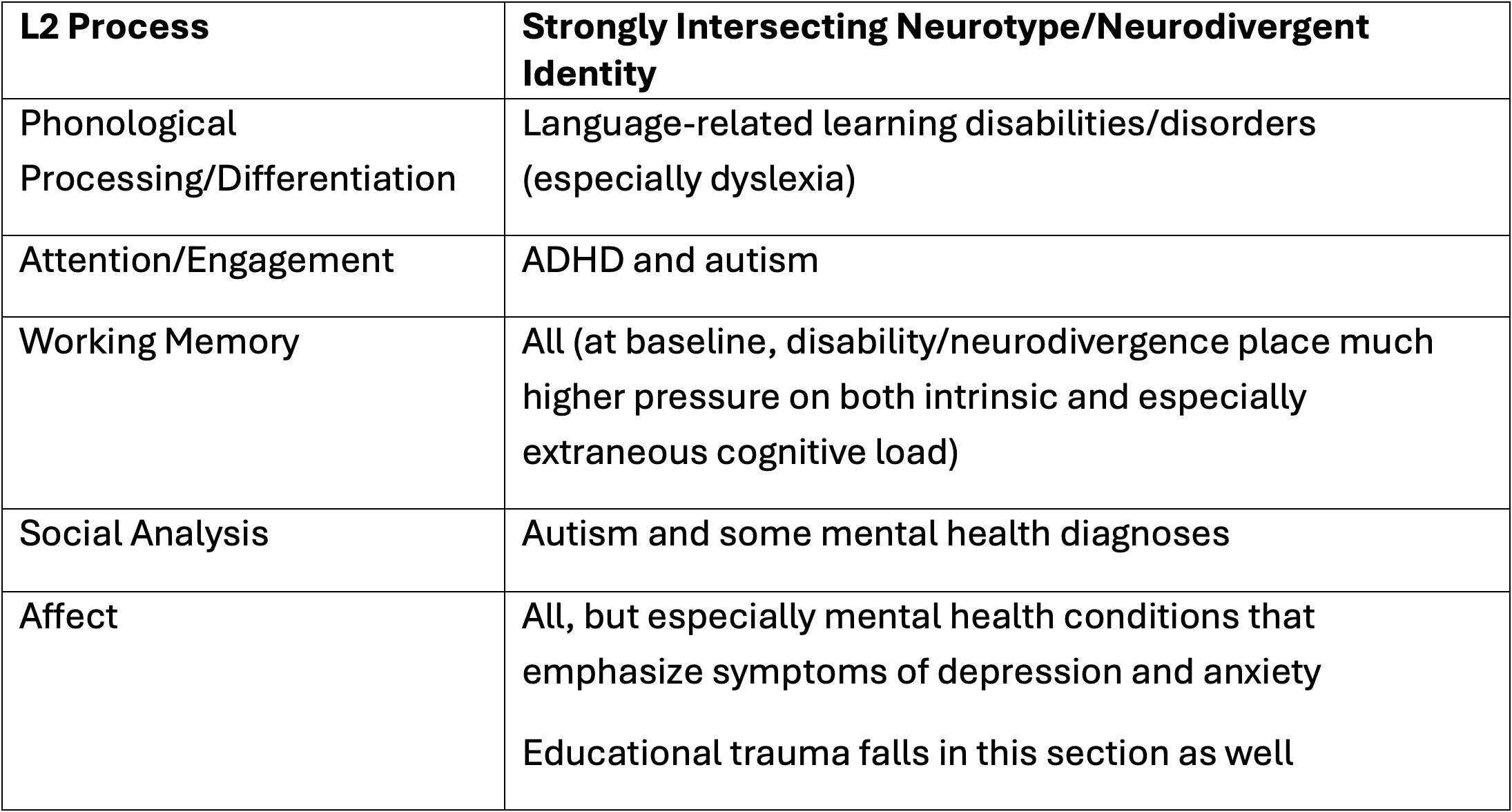
- Phonological Processing/Differentiation: Perceiving, parsing, recreating, combining, and manipulating the individual sounds in a language
- Attention/Engagement: Maintaining consistent focus to continuously listen and apply knowledge
- Working Memory: Intaking language, recalling knowledge, and applying this knowledge while holding it “in your mind” or sequencing information (esp. relevant for syntax and grammar)
- Social Analysis: Utilizing body language, inflection, and tone to create meaning
- Affect: Mood can impact motivation, self-confidence, persistence, attitudes toward educators or peers, and willingness to practice/take risks/engage with feedback
When we consider these five areas in the context of various neurodivergent identities, we can start to see some clear patterns for why L2 might be more challenging than average for a neurodivergent brain: the intersection between these L2 cognitive processes and commonly impacted cognitive processes in certain neurodivergent profiles is strong and consistent. A few examples are highlighted below:
So...are L2 requirements actually more challenging for neurodivergent brains?
We’ll leave the final conclusions up to you.
Regardless of your decision, these insights remind us that behaviors that can look like resistance, lack of motivation, or “poor effort” are often a reflection of misalignment between instruction and cognitive demand. For neurodivergent learners, the challenge isn’t simply about trying harder—it’s about needing different kinds of support.
As educators, families, and advocates, we have an opportunity to examine our expectations, flex our approaches, and create language learning experiences that honor diverse ways of thinking. Even small shifts in instruction, mindset, or policy can widen the path—without lowering the bar. Universal Design for Learning is a great philosophy to keep in mind, and CAST.org is a wonderful free resource for ideas! LCIRT also offers a range of professional development around teaching and learning strategies for neurodivergent students through our certificate program and custom professional development.