June 18th: The Abbey Theatre
[By Jack Phillips and Mia Robin Markeloff]
The Abbey, Ireland’s National Theatre, is only a short walk from the northern banks of the River Liffy. On the afternoon of June 18, our group tromped in through the glass doors to the red-carpeted lobby for the backstage tour.
Upon passing through the glass doors, visitors are greeted with a red-carpeted lobby with a little cafe and coat check to the left and a box office to the right. One of the first things that draws the eye is the intricately designed Abbey Theatre logo on the far wall, facing the doors.
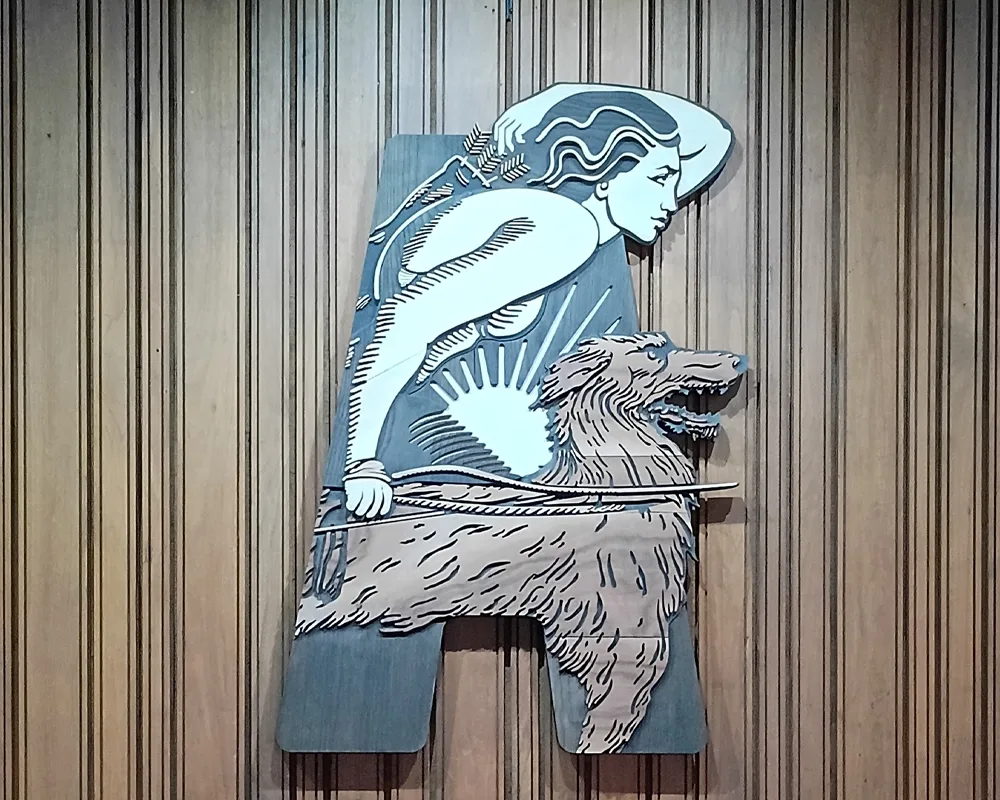
When the tour started, the man who was our guide had us gather there in a semi-circle around him. He was smiling and bearded and wearing a black polo shirt, and told us while the woodcut-style design was part of the original Abbey Theatre logo, the way the depiction of Queen Maeve and her loyal wolfhound interacted with the letter “A” was recently rebranded, part of the effort by the Abbey Theatre “to look to the past with an eye on the future.”
The new logo has its designs artistically crossing over the borders of the letter “A”, and the old logo had Queen Maeve and her loyal wolfhound confined to the borders of the letter A. In 1904, the theater doors opened with the intent of reclaiming what it meant to be Irish and reject negative portrayals of Irish people in the arts. That long-ago opening night in the heart of Dublin was a dream of Lady Gregory and W. B. Yeats come to fruition, and for over a hundred and ten years, it has been kept alive with the buzz of audience chatter before the lights go down in the auditorium, the actors coming out onto the stage to breathe life into their characters for another evening.
The first day the Abbey Theatre welcomed actors and patrons alike was twelve years before Patrick Pearce came out of the General Post Office, stepped into the street, and read the Proclamation of the Irish Republic to passerby. It was over a decade and a half before Ireland had its own government. The tour guide told us the Irish people did it “back to front”, putting the cart before the horse—there was a theater of Ireland before there was a government. The tour guide said with a smile, “we punch well above our weight in the arts.” The understanding of one of the authors of this blog on the matter is that the Irish people value their arts and culture because within their rich history of literature and oral tradition is what it means to be Irish.
The ability of Ireland to cultivate artists and writers of all kinds likely comes from easy access to places steeped in history and culture such as the Abbey Theatre. We learned that tickets could vary between 15 euros to 50 euros (the seats at the back and front are the cheapest, and the ones in the middle are the most expensive), and the tour guide’s explanation of ‘why’ was that those lowered costs would make theater more accessible to the public. Instead of this historical and cultural icon of Ireland being price-locked, the prices are kept lower to open the doors to more people, continually bringing culture and the arts to a wider audience.
One of the ways the Abbey can bring in funds is through the play “The Whiteheaded Boy,” which it owns full rights too. There is a story behind that. When the King of England died in 1910, theaters all across England closed, but the telegram sent to the Abbey Theatre was, as the tour guide put it, ‘delayed’ ‘misplaced’, ‘lost’, and my personal favorite, ‘blew into the River Liffy,’ where it doubtlessly died a soggy and inglorious death.
That evening, Lennox Robinson made the call to keep the doors open and put on a play even though it was a day of mourning for the King. The Abbey’s chief patron, Annie Horniman, who was British and had come from ‘tea money’, was so offended she withdrew her funding. Robinson made up for the revenue lost by placing the rights to his play “The Whiteheaded Boy” in the Abbey’s hands. Money from productions of that play return directly to the theatre. In fact, our tickets from the evening of June 18th to see that very play put money back into the Abbey, and perhaps to the future construction of a new theater. The tour guide told us all near the close of our tour that he would like a new Abbey Theatre to be a building that will carry the arts in Ireland “into the next hundred and twenty years”, and I hope he gets his wish.