June 17th: Book of Kells and Trinity Library
[Authors: Mia Robin Markeloff and Becca Rochford]
The first few days of this trip have taught me the meaning of “footsore”, but when I reflect on our walk through a sliver of Ireland’s rich cultural heritage earlier today, I find it entirely worth it. No aching feet would have stopped me from pulling the curtain back on history to peer into the past at the one and only Book of Kells.
Venturing back through time to the illuminated manuscript is an experience that starts with the grounds of Trinity College. Like so much of the city of Dublin, the grounds are a mix of old stonework buildings and modern glass. Our journey started at the Book of Kells exhibit on the ground floor, and moved to the floor above, the awe-inspiring Long Room of Trinity College.
I found myself just as hushed with awe there as I had been awash with fascination in the Book of Kells exhibit. To understand the Book of Kells as a labor of devotion from multiple pairs of hands and to feel the weight of hushed awe settled over the visitors in the vaulted dark brown bookcases and wide, airy atrium of the Long Room made the sore feet entirely worth it. The exhibit includes the original copy of the Book of Kells, over a thousand years old. Becca shared these thoughts:
Seeing the Book of Kells was very interesting and fascinating. I felt very moved by it because it felt like I was walking up to an altar at a church about to read or look at a Bible. I’m not a religious person at all, but that’s just how I felt when I first saw it. I tried to read the pages that it was flipped to but had trouble reading them.
We walked from there to the Red Pavillion.
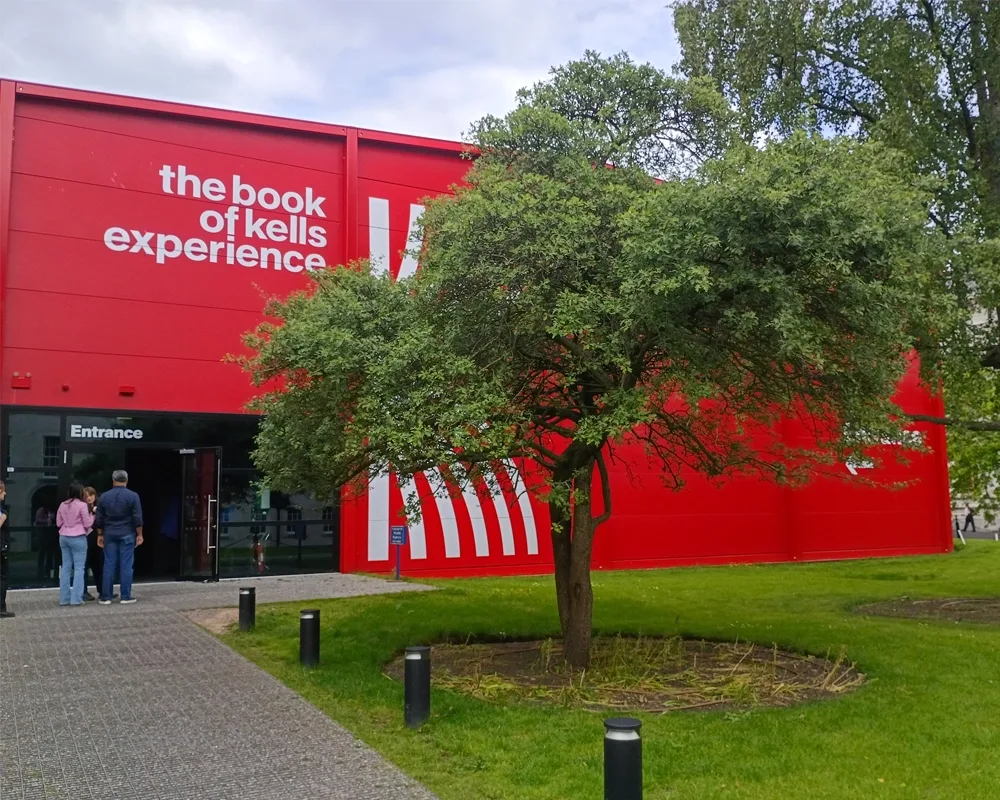
The Red Pavillion bills itself as the Book of Kells experience, but it is more than that. The multimedia experience of the first room was amazing. The contributors to the exhibit brought the cultural relics of Ireland’s past to life with gorgeous color and pretty melodies. One item that caught my interest was the symbol of Ireland.
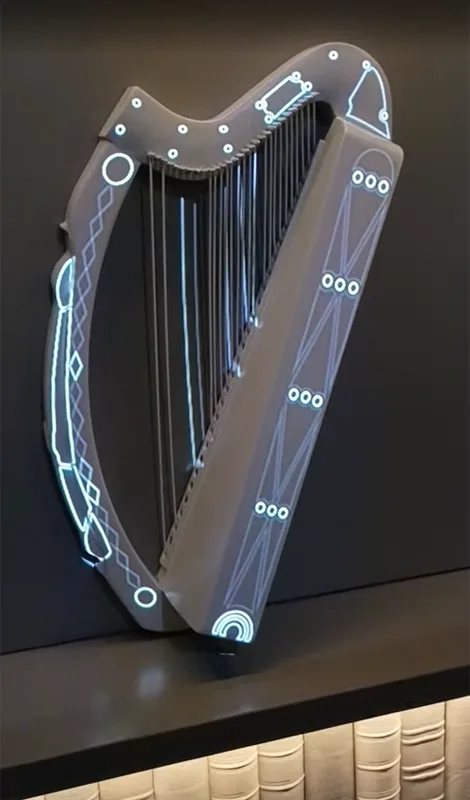
When Scott’s Lamentation For the Baron of Longhmoe (1599) emanated from the harp of Brian Boru, it lit up along the etchings on the harp’s frame. In the next room, the story of the origins of the Book of Kells is a surround sound and video experience. The entire room has video sprawling across the walls, ceiling, and floor. When the little one-sailed boats of the monks were tossed by stormy seas on their harrowing journey from the island of Iona, where the book was created, to the east coast of Ireland, waves lapped along the floor at the viewers’ feet. The rolling green hills of Ireland "move past" the viewer as they travel further inland, while an image of an illustrated man, in the style of the Book of Kells, watches from a spot behind the hills.
Becca writes:
The Monks of the monastery of Iona chose to protect the Book of Kells from the Vikings. They travelled across the sea where any giant wave could have knocked the book over the side or sunk the boat. They landed on the east coast of Ireland, where they traveled thirty miles inland to the Monastery of Kells. At one point, the book was stolen but then it was found buried underground. Unfortunately, the cover, inlaid with gems and jewels, was gone, only the inside of the book was recovered. In 1653 Charles Lambert donated the Book of Kells to Trinity College where it lies in a glass box till this very day.
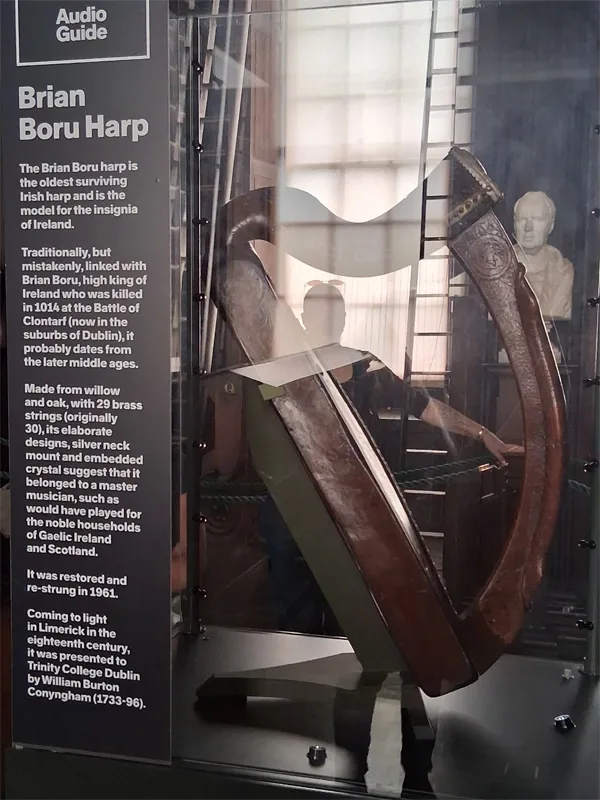
That video was an experience. I’m glad we got to see it, as well as the exhibits beforehand. They were astonishing. From this, I understood how important the arts, literature and music are to the Irish and how combining the modern and the old is a worthwhile pursuit for them in the 21st century. The original Brian Boru Harp is on display in the Long Room, but the “Red Pavilion” brought a replica to life with a tune from almost half a millennium ago.