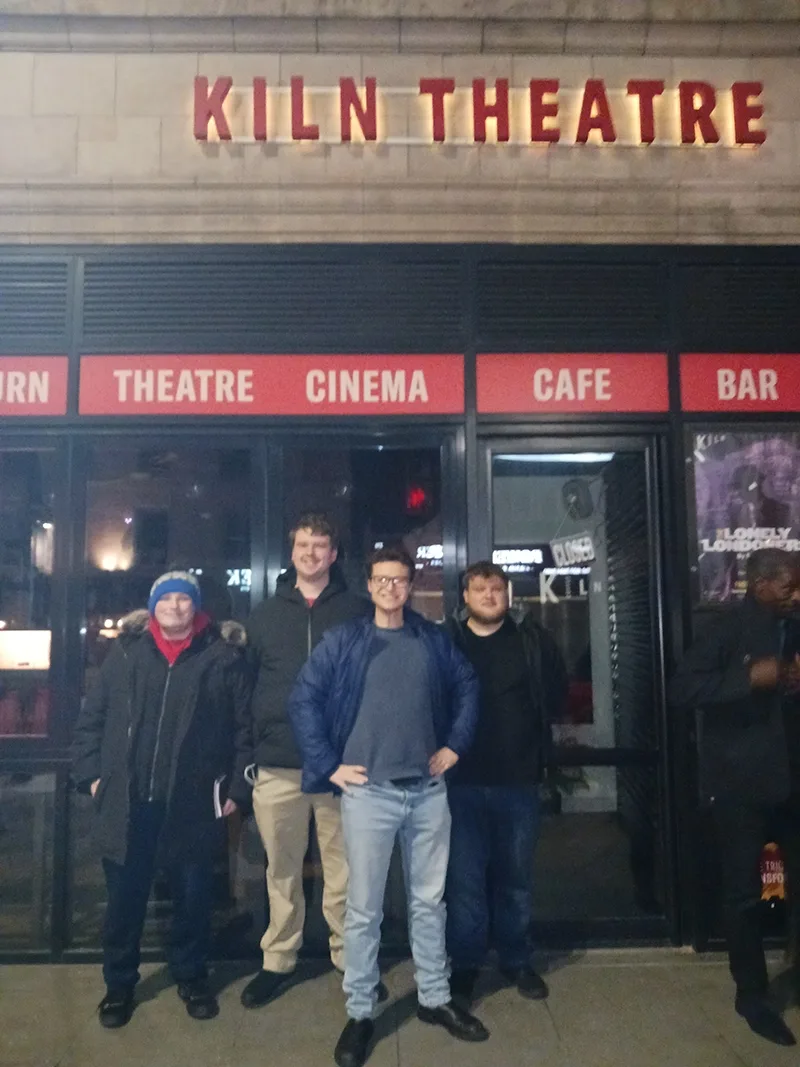
Kiln Theater
For our next theatrical performance, we travelled to north London via the Jubilee line to Kilburn where we saw a production of "The Lonely Londoners" at the Kiln Theater. The play, by Roy Williams, is set in 1956 and based on Sam Selvon's seminal novel about the Windrush generation in London. At the beginning of the play we are introduced to the character, Henry ‘Sir Galahad’ Oliver, who is newly arrived from Trinidad and eagerly awaiting the start to his new life in London.
Students continue to hone their critical eye by witnessing these performances. Here are some selected impressions from students after seeing "Kyoto" at the Soho Place Theater earlier in the trip.
This play is extremely important and only grows more important by the day. It is not a pretty play, it feels as if you are watching a sinking ship, only barely being kept afloat by a man committing all his energy and lifeblood in politics to keep it afloat, while another does everything in his power to stop him. The conflict between Estrada and Don is the focal point of the story, one a man who will stop at nothing, even the destruction of his own career, to make sure that the world will be a better place for his children, country, and the world. The other, someone who ignores his family, drowns out the world, and only focuses on what is in front of him. He knows he is wrong, he knows he should act, but he is so deep into his own rhetoric, that he refuses to admit that he could be wrong. This is a story of how somehow, countries who were at war, who hated each other to the point of mutually assured destruction, somehow came together to agree on one thing…The play is meant to show that despite everything, despite all the factors that are working against everyone, hatred, special interests, unclear procedures, and backroom politics, sometimes we can agree. Sometimes, we can sit down and enjoy the cherry blossoms, gain that glimmer of hope for 5 days that the world could become better, that we can work together again and create real change.
-- by Sky Larson
Our narrator is a lawyer named Don Pearlman. He takes us back to the 1990s when there were many meetings at the UN about climate. The play also details specific themes, such as climate change, the influence of corporate lobbying, moral dilemmas, and political negotiation. Those themes come into play throughout the show during the delegates' meetings from all those countries, especially when Angela Merkel came into the scene and the arguments about how countries' economies could crash if they reduced their fossil fuel intake. It took Don convincing Saudi Arabia's delegate to propose something that would help to make people agree. There's also the fact that the theme of corporate lobbying came into play with the Seven Sisters hiring Don to sabotage the climate talks or at least stall them enough. Angela Merkel, suspicious of Don, has Raoul banned Don from the meetings as he has disrupted the exposé that a German magazine did. Merkel most likely caught on to Don's plan to delay actions taken against climate change.
-- by Lukas Pelletier
There are several big themes including humanity behind politics, when I say this I’m referring to the personal stories that are displayed throughout the play, specifically with Don Pearlman. I feel like it emphasizes the idea that everyone is the hero of their own story. There are different people representing their respective countries each with their own set of concerns. For example, towards the beginning of the play we learn that the woman representing Kiribati has expressed great concern towards the rise in climate change fearing that smaller islands will be submerged. This actually leads us into another key theme in this play and that is Climate Change. The first half of the play really emphasizes the restlessness and urgency that is evident in the many debates these representatives have. This really hooked me because I’m very much aware of the ongoing concerns that water levels will rise as a result of climate change. Then there are diverse perspectives. This play showcases a variety of different viewpoints across different countries. There is a lot of tension between the developing and the developed nations. With developed nations prioritizing economics while developing nations are fighting to survive with less resources and luxuries available.
-- by Charles Karwowski