Students find friends, self-acceptance in Landmark College summer programs
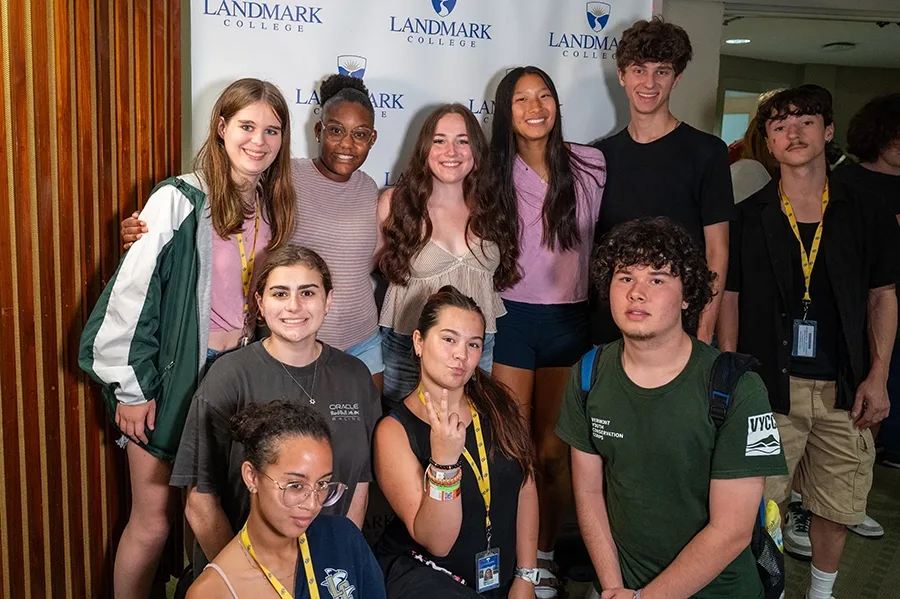
On a nature walk to retrieve maple soft serve less than a mile from the Landmark College campus, a pair of high school students started asking each other questions, and soon discovered they both like to cook.
Looking back on this year’s round of Landmark College summer programs, leaders name these new connections among the most important aspects of the experience.
“My favorite part is really watching the evolution of students, from when they arrive and they're anxious or reticent and unsure how it's going to go. By the end of the first week, they are really navigating campus and making social connections,” said Liza Burns, academic director for the High School Summer Program and associate professor of communication.
“Certainly, by the last week, some of them are reticent to go home.”
During the nature walk, which took students on a dirt road along a wetland preserve, the young people gathered into smaller groups, talking and laughing among themselves. Their destination was a barn-like structure with high post-beam ceilings, where they took turns choosing between maple, chocolate, or twist in a cone or a cup. For the full Vermont experience, one student even sampled a small flight of maple syrup.
The nature walk to retrieve soft serve (or, in Vermont, “creemees”) was among several social activities open to students in the Landmark College High School Summer Program, one of the College’s four summer programs designed to enable students to identify their learning strengths and differences. Students learn specific strategies to be successful in formal academic settings and grow personally and academically in an intentional and supportive academic community. The instructors consist of current Landmark College faculty as well as teachers from the surrounding area and beyond who are experienced in working with students who learn differently.
Mea Hilton, of Cambridge, Mass., said the high school program gave her rising senior the confidence to pursue a four-year degree program.
“I know when I dropped them off, they were incredibly nervous,” Hilton said. When she picked them up, they told her, “‘I can do a four-year college, now that I’ve seen what it is.’”
Hilton said her teen enjoyed all of their classes, which covered research and writing, field ecology, and study skills for different learning styles. She said the roommate selection process led to a perfect match for her shy teen, and the program offered a good balance of structure and independence.
“It was structured, but not overly structured,” Hilton said. “As the parent, I really appreciated that there were evening things,” including a nightly meeting that got everyone back out of their rooms and engaging with one another.
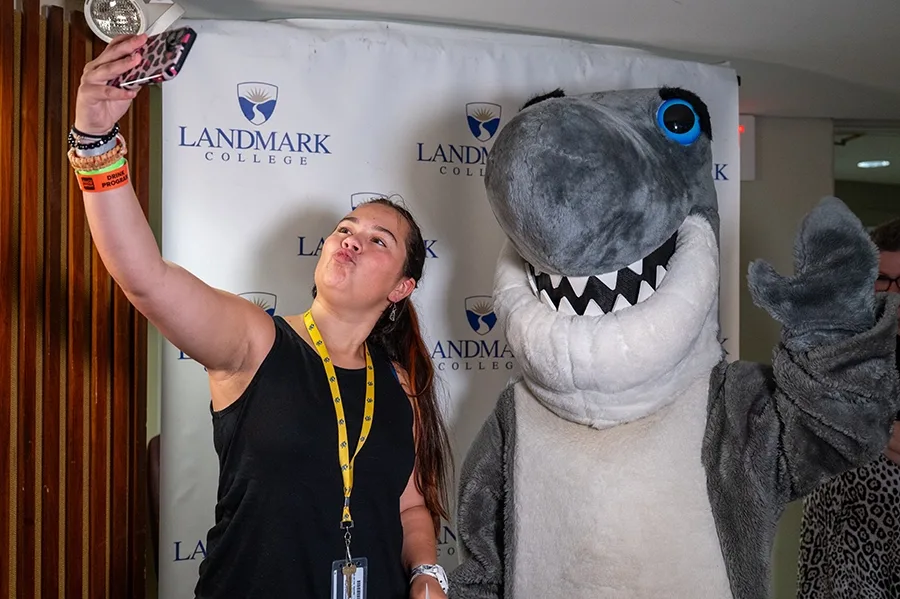
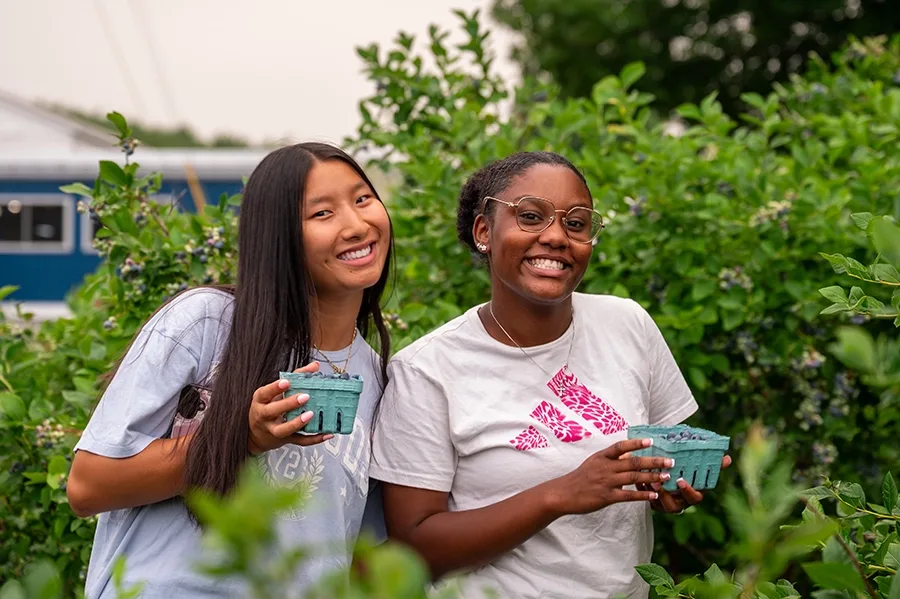
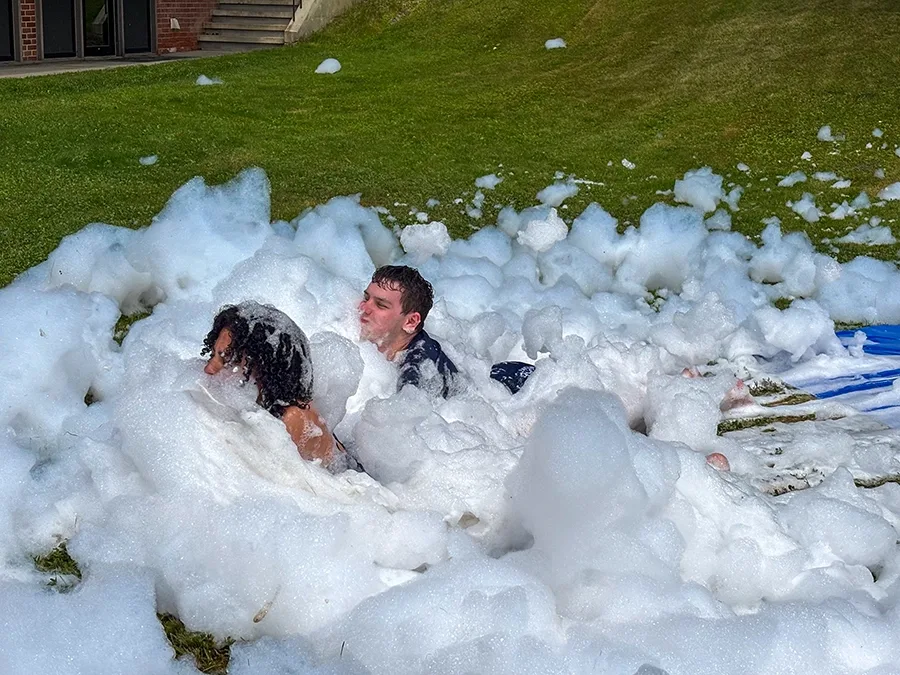
In addition to the nature walk to get creemees, other activities for this year’s summer program participants included blueberry picking, trivia and bingo nights, and a “silent disco,” in which students wore headphones and chose their own music. Higher-intensity options included indoor rock climbing, lawn games such as gaga ball and tether ball, a ropes course, and a slip-and-slide. On Shark Day, a small outdoor festival on the campus quad, one of the most popular attractions was a mechanical shark — like a mechanical bull, but a shark in the spirit of Landmark’s mascot.
Scott Forthofer, director of student involvement & leadership development, said in past years, students in the high school program would identify their top three choices for activities and then be assigned where they fit.
This year, the students signed up for activities directly, which became a learning experience in itself. For example, a group of students would want to do an activity together, but the activity wouldn’t have enough slots open.
“So as a group, they decided what everybody would be open to do, which helps grow their critical thinking skills,” Forthofer said. “Sometimes, someone was like, ‘Well, that’s OK, I’m going to go do this. You guys can go ahead and do that.’ So it showed that this person really wanted this program.”
At Landmark College, the on-campus summer programs are: High School Summer Program, which provides high school juniors and seniors an introduction to college life; Summer College Readiness Program, which prepares college-bound high school graduates for the transition; and Summer Bridge Experience, designed to help current college students with learning differences reach their potential. Remotely, there is a Five-Day Online Bootcamp for incoming and current college students with learning differences.
Rebecca Matte, academic director for the Bridge Experience and professor of education, said the program allows students to work through their challenges in a safe, supportive environment.
“At a very granular level, we help students accept and own who they are,” Matte said. “That’s part of the process.”
Matte sought to help students directly whenever she could. For example, if there were students who missed class, she would gently approach them and try to figure out how to get them to class.
“We could process it in a really healthy, nonthreatening way,” Matte said. “We’re not out to get you. We're out to help you figure out what got in your way, and is there anything you can do to control it, and if so, what is that?”
Amy Chadwick, an adjunct professor who teaches in the Bridge Experience, said one of the most important parts of her curriculum is helping students to “stop beating themselves up so much.”
“That helps reduce their anxiety, and it helps increase their chances for success when they go back home,” Chadwick said.
Chadwick taught Narrowing the Gap, a class that teaches students about self-awareness and self-advocacy through a lens of neurodiversity.
“I don't have one student that didn't have higher confidence by the end of the summer than they started with,” Chadwick said. “Not always in the same area, not always in the same domain. Some, their confidence increased in their ability to do work. Some of them, their confidence increased in their ability to socialize.”
Tyler Baker, academic director for Summer College Readiness and assistant professor of history, said the goal is to create a college-like environment where students can learn to effectively use their time and identify areas for growth.
“Is it studying skills? Is it making a schedule? Is it being able to interact with your peers?” he asked. “Or is it just knowing that you can be on your own, away from your family, and feel like you can sustain good, everyday living while also being confident in your ability to do college?”
Beyond the classroom, the College Readiness participants traveled to surrounding towns, where they took part in volunteer activities — led by Eric Gobel-Lynch, the College’s director of transition programs — such as litter pickup and clearing invasive plants.
“We go out into the community to do some service and some learning about how college students, even though they are primarily residents of their campus, they’re also citizens in the broader sense of being in the region and giving back and having the power to do those things to connect to something bigger than themselves,” Gobel-Lynch said.
These trips were also opportunities for students to get to know one another while working toward a common goal.
“One of the things that continually was brought up over and over by students was the degree to which they were excited about meeting people that they just didn’t know they had the chance to meet,” Baker said.
Learn more about Landmark College summer programs.