History Professor Tyler Baker Wins NSF-Funded Research Grant to Quantify Neurodivergent Student Narratives
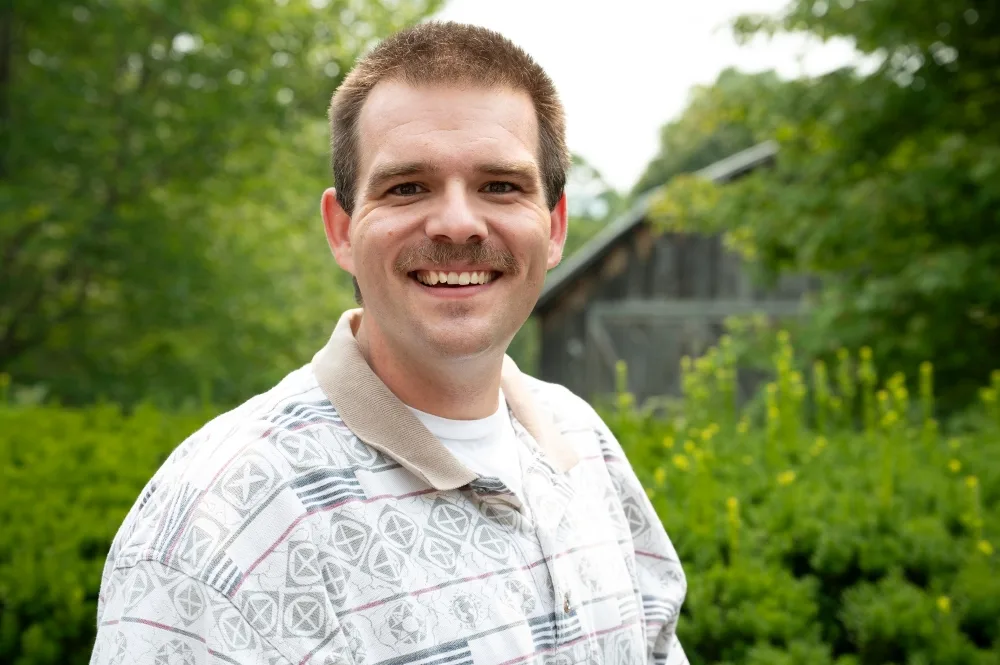
Landmark College Assistant Professor of History Tyler Baker, PhD has been awarded a 2026–2027 Vermont EPSCoR Pilot Research Grant to explore a question that sits at the intersection of the humanities and data science: how can the personal stories of students be quantified and analyzed?
The grant awards more than $16,000 to fund Baker's project, Quantifying Struggle: A Pilot Study for Narratives of Students with Learning Differences in American Higher Education, from June 1, 2026 through May 31, 2027. The grant comes through Vermont EPSCoR's Research Infrastructure Improvement Track-1 initiative, "Harnessing the Data Revolution for Vermont: The Science of Online Corpora, Knowledge, and Stories" (SOCKS), and is supported by the National Science Foundation.
Students with learning differences often describe their college experiences through personal narratives — stories rich with insight into access and belonging, struggle and persistence. Yet those stories are rarely examined with the quantitative or computational tools now common in other fields, Baker says.
That’s what led Baker to propose research that utilizes large language models and other leading social science methods to analyze interviews Baker conducted for his forthcoming book, Alone in the Crowd: A History of Landmark College (University of Vermont Press, 2026).
“Student’s stories of struggle and persistence are usually treated as anecdotes, not evidence,” Baker said. “This research project asks whether and how we can measure what those narratives hold without flattening their complexity,” he continued.
Drawing on a collection of roughly 60 oral history interviews with Landmark College students and alumni conducted between 2024 and 2026, Baker will build a small, curated, anonymized collection of up to 40 narratives. He will then apply exploratory computational methods — sentiment analysis, keyword frequency and clustering, and topic modeling — to surface emotional, linguistic, and thematic patterns across the accounts. The results will be translated into data visualizations alongside a written reflection on where such methods illuminate disability-focused storytelling and where they fall short.
In their interviews with Baker, students and alumni reflected on academic challenges, persistence, and support structures, and reported a range of learning differences including autism, ADHD, executive functioning challenges, dyslexia, and dyscalculia.
Baker emphasizes that the goal is primarily methodological. “The ultimate goal is to develop and share a framework with fellow researchers to better analyze and uplift the voices of students who learn differently,” he said, seeking to inform larger, future research.
An undergraduate research assistant will work alongside Baker on transcript preparation, data organization, and documentation, gaining hands-on experience with research software and cutting-edge quantitative and computational social science research methods.
The project is housed in Landmark's Humanities Department and will draw on guidance from the Landmark College Institute for Research and Training (LCIRT), established in 2001 to advance research on learning disabilities, ADHD, and autism spectrum disorder. The grant was awarded by Vermont EPSCoR and the Vermont Space Grant Consortium at the University of Vermont.
“Landmark College and LCIRT are proud to support Professor Baker’s innovative scholarship and are thrilled to be working with our partners at the University of Vermont EPSCoR program,” said Vice President for Neurodiversity Research and Innovation Adam Lalor, PhD.
“This work foregrounds neurodiverse voices largely absent from large-scale educational datasets and makes important contributions to emerging work in narrative analytics and inclusive data science,” Lalor continued.
Baker joined Landmark College in 2023 and was named Assistant Professor of History in 2025. He holds a PhD in Educational Leadership, Curriculum and Policy from Miami University, and his scholarship focuses on the history of access and learning disabilities in American higher education.