At LC Visit, Devon Price Talks About Neurodiversity, Living Authentically
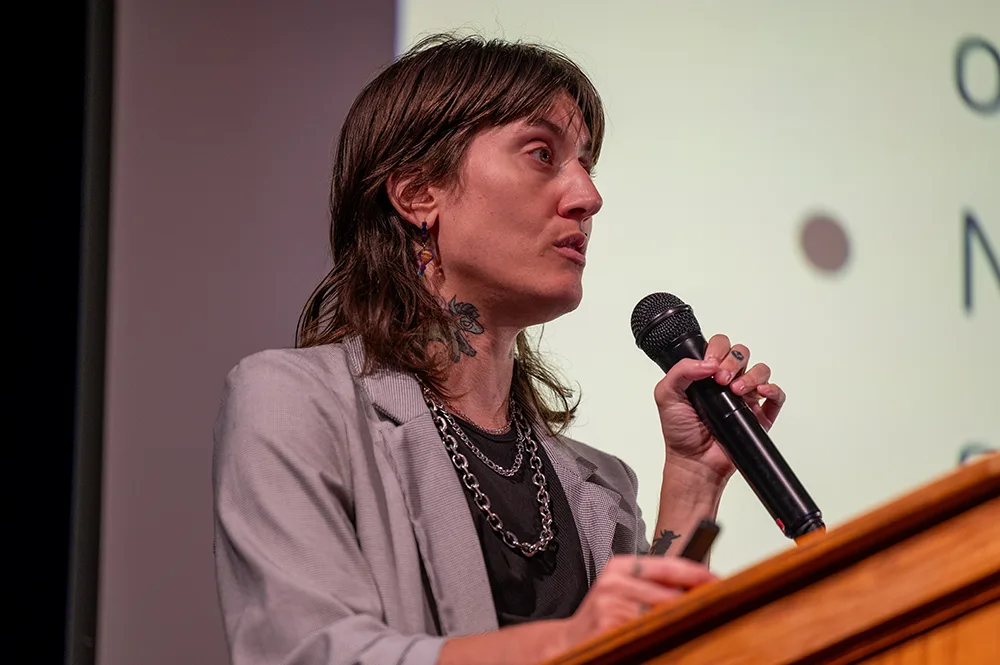
At a talk by social psychologist and proud autistic person Devon Price, Landmark College student Raziel Ferguson asked what Price thought of the word “weirdo.”
“I mean, I love it,” Price said. “I love ‘weird,’ ‘freak.’ It’s all individual preference, but I’m very, like, ‘Let’s reclaim it. Let’s lean into it.’”
This sentiment captured many of the points Price made during the talk Wednesday evening in the College’s Greenhoe Theater — especially the practice of tolerating the discomfort of not being liked or accepted.
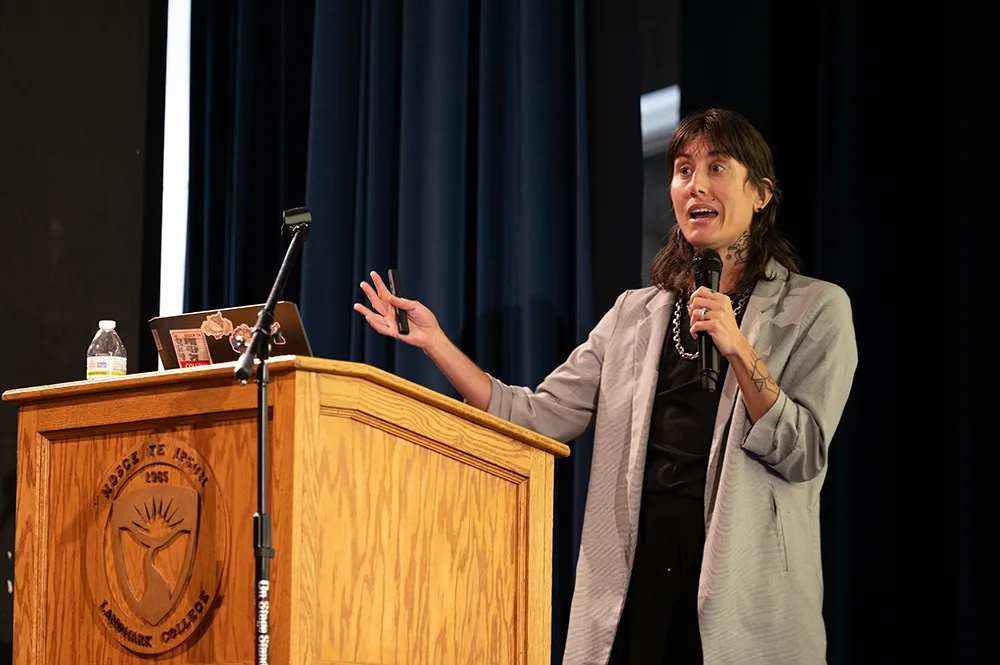
“There is some amount of letting people think you're wrong and doing the thing anyway that is a really powerful social skill,” Price said. “It really makes you a lot more powerful and resistant to conformity pressure if you're willing to say, ‘Some people disagree with me, but I'm still going to do what I think is right, no matter how uncomfortable or awkward that is.’”
The event was part of the Fall 2026 Landmark College Academic Speaker Series, and Price’s talk was called, "Neurodiversity and Authentic Self-Expression and Self-Advocacy."
Price is the author of two books about autism, “Unmasking Autism: Discovering the New Faces of Neurodiversity” (2022), and “Unmasking for Life: The Autistic Person's Guide to Connecting, Loving, and Living Authentically” (2025), as well as a book about burnout and a book about shame. Masking can be defined as consciously or unconsciously suppressing or hiding one’s neurodivergent traits.
Solvegi Shmulsky, academic dean of liberal arts and professional studies and professor of psychology, hosted another session for students earlier in the day. She described Price’s evening presentation as fast-paced and full of advice that anyone can put into action.
“I love how Devon unpacked and rebuilt advice for people on how to live authentically,” Shmulsky said. “Students shared their own stories and had great questions. It made me proud to see such sophisticated comments and questions from students during the day and at the event.”
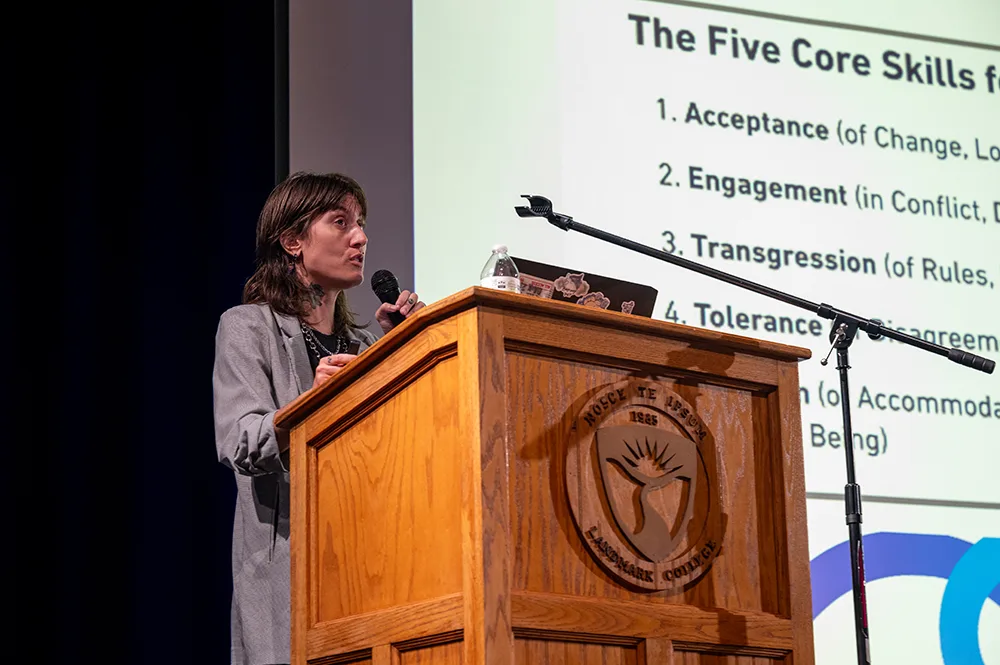
Price spoke in-depth about the topic of neurodiversity and ways to unmask, noting that while the presentation mostly focused on autism, the term "neurodivergent" and the experience of masking can apply to other diagnoses. These can include attention deficit hyperactivity disorder (ADHD), obsessive-compulsive disorder (OCD), and post-traumatic stress disorder (PTSD).
“I have so much to infodump here,” Price, a clinical associate professor at Loyola University Chicago, said.
Price said masking is a skill, and not inherently bad, but can be unhelpful or detrimental to a neurodivergent person’s health when forced. For example, Price said people who mask a lot report more depression, anxiety, and loneliness.
“They say that their friendships have less depth and less quality than autistic people who don't mask,” Price said. “They often are at risk of substance abuse, addiction, (and) impulsive risk-taking behaviors because, we think, of the stress of having to pretend to be someone that you're not all of the time and having to erase your needs.”
Price discussed several social skills for unmasking. These include accepting change and uncertainty, engaging in conflict in productive ways, thoughtfully breaking social norms, tolerating discomfort, and creating accommodations.
“A lot of times, we have to create our own accommodations, our own solutions to problems of lack of accessibility because we weren't given the accessibility that we needed and deserved,” Price said.

During the question-and-answer session, student Isaac Fynewever-Muyskens asked Price, “How did you get into the career that you have?” to which Price responded, “It’s definitely creating-my-own-thing-out-of-a-crumbling-old-way-of-doing-things kind of situation.”
Price recalled getting burned out before being able to follow a traditional path toward becoming a tenure-track professor, instead opting for part-time teaching jobs and writing. Price’s writing connected with people, with some pieces going viral online, and an agent reached out about a possible book. Price’s first book, “Laziness Does Not Exist,” about burnout, was published in 2021. “Unmasking Autism” came out a year later.
Price humbly attributes a lot of this success to luck.
“Some of it also came from the fact that I was disillusioned with the academic program that I was in and the way to be successful,” Price said. “What I learned about myself was that I really liked translating science into something that was for everyone and talking to people that weren't just in the academy, and talking about my experiences and the experiences of other disabled people, and letting that inform the conversation.”
Events in the Academic Speaker Series are free and open to the public. To stay on top of future events in the series, visit the College's events calendar.