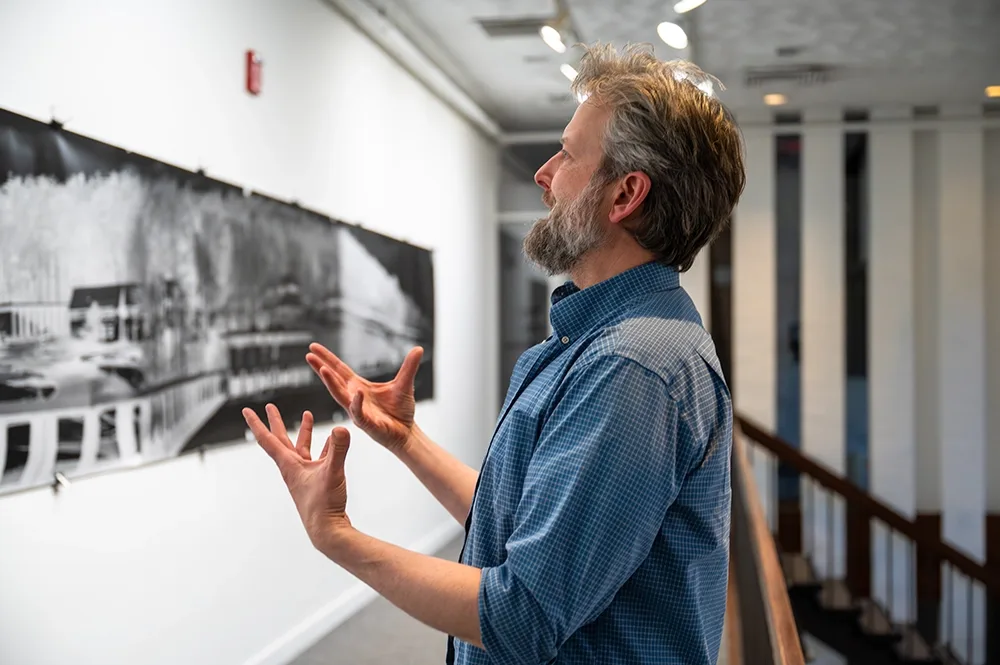
Walking into the gallery of the Fine Arts Building (FAB) right now, the first thing you'll see is a massive black and white panorama of the Quad. It stretches nearly the whole length of the upper balcony and—quite notably—is flipped horizontally.
This negative taken by Assistant Professor of Photography Luke Strosnider uses a very old photography technique known as pinhole photography. A pinhole camera is perhaps the most basic form of a camera. All that is needed is a box that can prevent light from entering, a piece of photosensitive paper, and a way to let in a tiny amount of light.
To take this photo, Strosnider blocked out all the windows in a room on the upper floor of the FAB and poked a quarter-sized hole in the covering over the window. On the opposite wall, he hung an enormous piece of photosensitive paper. That was actually the easy part of taking the photo. Strosnider's choice of traditional photosensitive paper meant the image had to be developed.
Most times, when developing film photos, small plastic tubs (like you might put your shoes in while going through a TSA checkpoint) are used to hold a series of chemicals that develop and set the photo. For a photo this large, however, the standard method simply was impossible. Instead of a tray, Strosnider found a deep sink that could fit the entirety of the 40-foot-long sheet, but only if he rolled it up. So, he plugged the drain, poured in the chemicals, and then “unrolled it.”
“I did this a few times—unrolling, reversing—to ensure full development,” Strosnider said. “It was, as it always is, a magical feeling to watch the print emerge on the paper.”
The last step in the process was to lay the paper out across the floor of the fourth-floor lighting studio to dry. Strosnider employed a windshield wiper-like squeegee to remove any excess chemicals.
Strosnider said that he wanted to take an image of the campus, using the FAB as the camera, “to make the building a machine of art making.”
The image is part of an exhibition called Project Space INDIGO, which focuses on “the intersection of light, apparatus, audience, and artist," according to the collective artist statement. The other two featured artists are Michael Alexander Morris, an experimental filmmaker; and Allison Leigh Holt, an artist who focuses on the interaction of light and glass, and the exhibition will be on display through April 26th.
The gallery within the FAB is open to the public from 10 a.m. to 4 p.m. on Mondays, Tuesdays, Thursdays, and Fridays.
Learn more about Landmark College’s Integrated Arts program.