$7.9 Million NSF Investment Includes Landmark College Researchers in Collaboration to Address ‘Forever Chemical’ Contamination
The U.S. National Science Foundation has awarded $7.9 million to establish the PFAS Environmental Research Network (PERN), a four-year initiative bringing together Vermont researchers, educators, students, and state partners to better understand and address environmental chemical contamination.
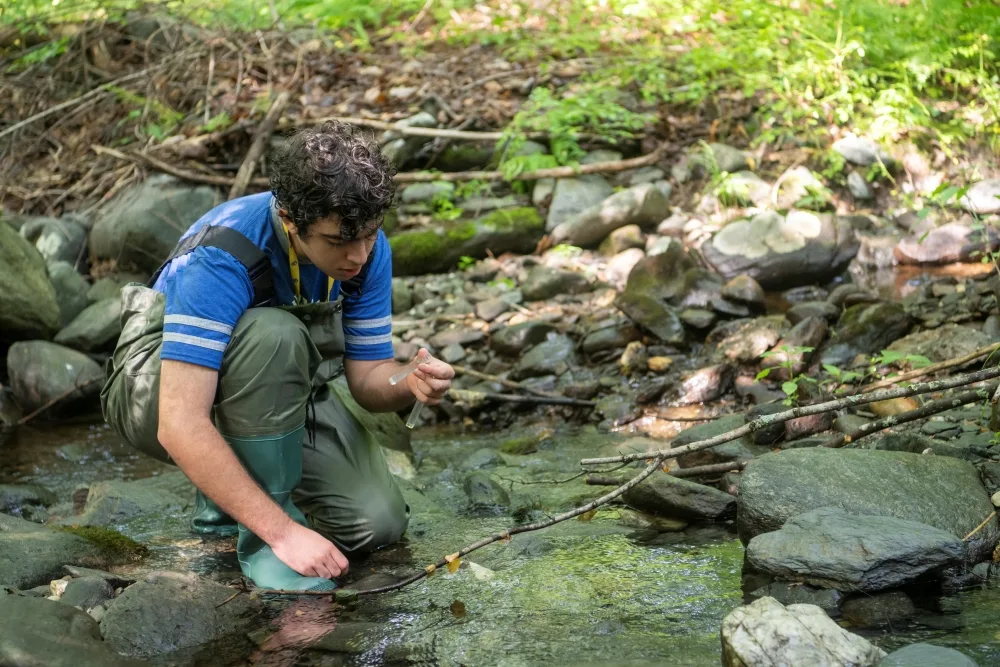
Landmark College faculty Denise Burchsted and Ally Hunter, Principal Investigator (PI) and Co-PI, respectively, will lead research involving Landmark College students, who will collect and contribute data to the collaborative network.
The PERN network will include Landmark College alongside Bennington College, the lead institution on the award, as well as Middlebury College, the University of Vermont, and state agencies in a growing effort to investigate where and how per- and polyfluoroalkyl substances (PFAS) are suspected to have contaminated groundwater and soil.
PFAS, also known as “forever chemicals,” are a persistent group of industrial and consumer product chemicals, including those used in nonstick cookware, that can remain in the environment for decades, affecting ecosystems and the communities that depend on them.
For Landmark College students, the award provides an opportunity to engage directly in scientific research alongside researchers and partners from across Vermont. Through the project, students will gain hands-on experience contributing to research addressing an environmental challenge facing rural communities affected by industrial contamination.
In reflecting on the significance of the award, Ally Hunter, Co-PI on the project, shared that while school like Landmark are primarily focused on teaching, "many of our faculty are trained researchers and our students are capable of meaningful participation in scientific discovery.”
Previous studies have focused primarily on PFAS contamination in water but less is known about how consuming contaminated food may affect human health. With a strong culture of hunting and foraging, Vermonters may be exposed to PFAS through wild food sources, yet few studies have investigated how these chemicals accumulate in terrestrial ecosystems.
This work will contribute data toward a more comprehensive understanding of how PFAS move through Vermont’s environment, accumulate in living systems, and potentially affect human health.
Burchsted, the project’s lead PI, said that the funding will be used to create opportunities for students to "engage in meaningful research and gain experience working across institutions and disciplines.”
PERN builds on growing momentum for multimillion-dollar federal research investments led by smaller institutions, including the 2025 NSF STRIVE award (#2438168), led by Landmark College in collaboration with Bennington College. Together, these investments represent another step toward building a more connected, collaborative, and competitive research ecosystem across Vermont.
Hunter concluded in saying that "funding that supports research at smaller institutions broadens participation in STEM, gives students authentic opportunities to contribute to emerging fields, and strengthens the network of researchers and institutions contributing to doing good science in Vermont."